Canada Rural Immigration Jobs in 2026: Employers and PR
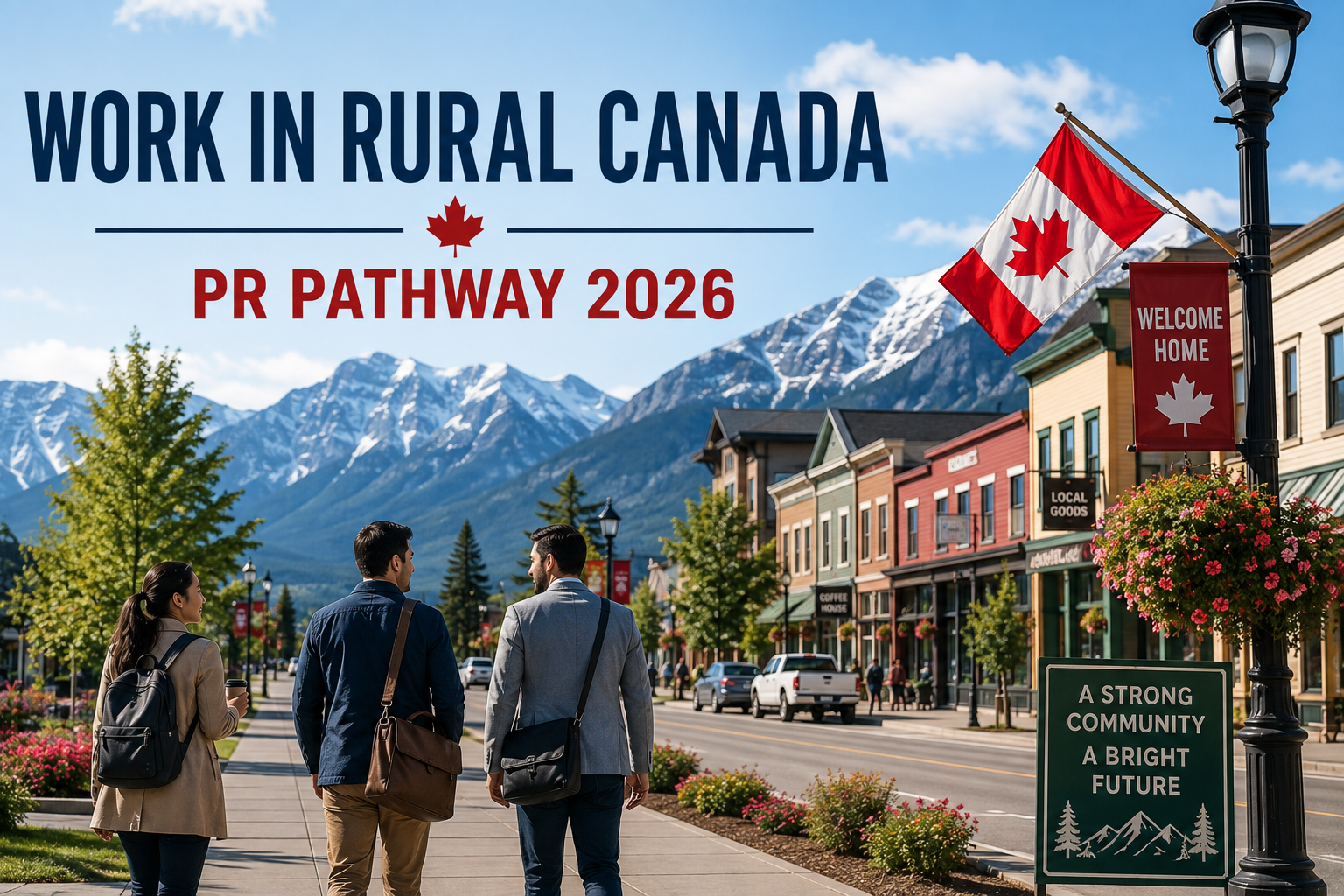
Canada Rural Community Immigration Pilot jobs offer skilled foreign workers an opportunity to work and settle permanently in selected smaller Canadian communities.
The Rural Community Immigration Pilot (RCIP) is currently open. Unlike a general job-search programme, applicants need an eligible job offer from a designated employer in one of 14 participating communities before they can move forward towards permanent residence.
This makes RCIP particularly interesting for foreign workers who are willing to build their careers outside Canada’s largest cities. Here is how the programme works in 2026.
What Is the Rural Community Immigration Pilot?
The RCIP is an economic immigration programme created to help participating rural and remote communities fill important labour shortages.
Each community identifies priority sectors and occupations based on its local workforce needs. It can then designate suitable employers to recruit eligible candidates.
If you receive a qualifying job offer, the employer submits your community recommendation application. Once the community recommends you, you can apply to Immigration, Refugees and Citizenship Canada (IRCC) for permanent residence.
You can review the official Rural Community Immigration Pilot before beginning your job search.
14 Communities Participating in RCIP
Canada selected 14 communities for the Rural Community Immigration Pilot. They are spread across Nova Scotia, Ontario, Manitoba, Saskatchewan, Alberta and British Columbia.
- Pictou County, Nova Scotia.
- North Bay, Ontario.
- Sudbury, Ontario.
- Timmins, Ontario.
- Sault Ste. Marie, Ontario.
- Thunder Bay, Ontario.
- Steinbach, Manitoba.
- Altona/Rhineland, Manitoba.
- Brandon, Manitoba.
- Moose Jaw, Saskatchewan.
- Claresholm, Alberta.
- West Kootenay, British Columbia.
- North Okanagan Shuswap, British Columbia.
- Peace Liard, British Columbia.
You should research more than one community. Each location has different priority occupations, employers and local economic needs.
How to Find Canada Rural Community Immigration Pilot Jobs
The most important part of the RCIP process is finding the right employer.
You cannot simply obtain any job in one of the 14 communities. Your offer must come from an employer that has been officially designated by the participating community.
IRCC states that individual communities publish their designated employers and available jobs on their own websites when they are ready.
You can use the official RCIP job offer page to access links to each participating community.
Do not assume that every employer located in Thunder Bay, Brandon, Moose Jaw or another participating location is automatically an RCIP employer.
What Makes an Employer Designated?
Participating communities decide which employers can recruit through RCIP.
IRCC requires designated employers to meet several conditions. Generally, an employer must operate in a priority occupation identified by its community, comply with employment standards and complete required training.
Employers normally need to have operated continuously for at least two years within the participating community, although provisions exist for certain businesses that have recently relocated or can make a substantial economic contribution.
At least 75% of the employer’s business work must generally take place within the community.
Staffing and employment agencies cannot become designated employers under the programme.
What Type of Job Offer Do You Need?
An RCIP job offer has specific requirements. According to IRCC, the position must generally be:
- Located within the participating community’s boundaries.
- Full-time, providing at least 30 paid hours per week.
- Non-seasonal and available throughout the year.
- Indeterminate, meaning there is no predetermined end date.
- Offered by a designated employer.
The job must also meet the programme’s occupation and wage requirements.
Therefore, a temporary three-month job or seasonal position would not normally satisfy the RCIP job-offer requirements.
Who Is Eligible for RCIP in 2026?
Getting an offer from a designated employer is only one part of the process. You must also satisfy IRCC’s immigration requirements.
Applicants generally need:
- A valid qualifying job offer from a designated employer.
- Relevant work experience, unless an exemption applies.
- An approved English or French language test.
- A qualifying Canadian educational credential or foreign equivalent.
- Enough settlement funds, unless exempt.
- A recommendation from the participating community.
RCIP Work Experience Requirement
Most applicants need at least one year, or 1,560 hours, of related paid work experience during the previous three years.
The experience must generally be paid employment. Volunteer positions and unpaid internships do not count. Self-employed work also does not normally count towards this requirement.
Your experience needs to relate appropriately to the National Occupational Classification (NOC) and Training, Education, Experience and Responsibilities (TEER) category of your job offer.
International Graduate Exemption
Some international graduates from publicly funded post-secondary institutions within the participating community can be exempt from the work experience requirement.
There are specific conditions covering the programme length, full-time study, time spent living in the community and when the qualification was obtained.
Therefore, international graduates should check the exact IRCC exemption requirements rather than assuming that any Canadian qualification removes the work experience requirement.
Language Requirements for Rural Immigration
You must prove your English or French ability through an approved language test.
For English, accepted tests include IELTS General Training and CELPIP-General. The language level required depends on the TEER category of your job offer.
This means there is not one universal language score for every RCIP applicant.
Arrange your test early enough to ensure your results remain valid when you submit your permanent residence application.
Education Requirements
Applicants must generally have an eligible Canadian educational credential or the equivalent of a Canadian secondary school education or higher.
If you studied outside Canada, you normally need an Educational Credential Assessment to demonstrate the Canadian equivalency of your foreign qualification.
The assessment must meet IRCC’s requirements and remain valid when you apply.
How Much Settlement Money Do You Need?
If you are not already working legally in Canada with a valid work permit, you generally need to demonstrate that you have enough money to support yourself and your family.
The latest IRCC table currently lists the following minimum amounts:
- 1 family member: CAD $10,507.
- 2 family members: CAD $13,080.
- 3 family members: CAD $16,080.
- 4 family members: CAD $19,524.
- 5 family members: CAD $22,143.
- 6 family members: CAD $24,975.
- 7 family members: CAD $27,806.
For each additional family member beyond seven, the current table adds CAD $2,831.
These amounts are updated periodically. Always check the latest RCIP settlement fund requirement before applying.
How to Apply for RCIP Permanent Residence
The process is easier to understand when broken into clear stages.
- Choose participating communities: Research their priority occupations and designated employers.
- Find an eligible job: Apply directly for suitable positions with designated employers.
- Receive a qualifying offer: The position must meet RCIP requirements.
- Get a community recommendation: Your employer sends the recommendation application to the community for review.
- Prepare your PR application: Gather your language, education, work experience, passport and financial documents.
- Pay the required fees: Follow the current IRCC fee schedule.
- Submit your permanent residence application: Apply online according to IRCC instructions.
The current federal application fee for the principal applicant under the Rural and Francophone Community Immigration pilots is CAD $1,590, including the processing fee and right of permanent residence fee.
A spouse or partner included in the application currently costs CAD $1,590, while a dependent child costs CAD $270. Other expenses, including biometrics, medical examinations, police certificates, language tests and credential assessments, can also apply.
Can You Work While Waiting for PR?
Eligible RCIP permanent residence applicants may be able to obtain an optional employer-specific work permit while their PR application is being processed.
This work permit can be valid for up to two years and allows the applicant to work for the employer that offered the qualifying RCIP position.
It is not automatic. You must satisfy the applicable requirements and have submitted your permanent residence application.
Eligible spouses or common-law partners may also be able to apply for an open work permit, although their employment is restricted to the same participating community.
Watch Out for Fake RCIP Job Offers
RCIP’s connection between employment and permanent residence makes it attractive to scammers.
Be suspicious of anyone claiming that you can simply pay for an RCIP job offer or guaranteed permanent residence.
The safest approach is to begin with the official participating community websites and verify that an employer is genuinely designated.
Also remember that the pilot itself does not match applicants with employers. You still need to search and apply for genuine vacancies.
Frequently Asked Questions
Can I apply for RCIP without a job offer?
No. You need a valid job offer from a designated employer in one of the participating communities before you can proceed through the community recommendation stage.
Can I apply from outside Canada?
Yes, being outside Canada does not automatically prevent you from applying. You still need to satisfy the programme requirements, including obtaining the required job offer.
Does an RCIP job guarantee permanent residence?
No. A job offer is an important requirement, but you must also receive the community recommendation and satisfy IRCC’s permanent residence requirements.
Can my family come to Canada?
Eligible family members can be included in a permanent residence application. Different requirements can apply depending on the family member and circumstances.
Final Thoughts on Canada Rural Community Immigration Pilot Jobs
Canada Rural Community Immigration Pilot jobs provide a particularly interesting option for skilled workers who are willing to build a long-term life outside Canada’s biggest metropolitan areas.
The key is to search strategically. Choose from the 14 participating communities, identify their priority occupations and only rely on employers officially designated under the programme.
If you secure an eligible offer, the community recommendation can provide a pathway towards Canadian permanent residence, provided you also meet the federal eligibility requirements.
Disclaimer: Canadian immigration rules, participating employers, priority occupations, settlement funds, application fees and community requirements can change. Always confirm current information through IRCC and the official website of the participating RCIP community before applying or making financial decisions.