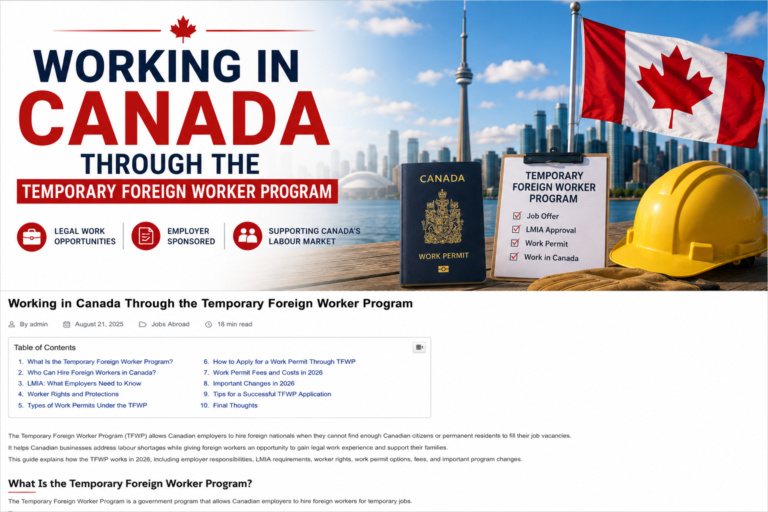

10 Pathways to Migrate to Canada Easily
There are several legal ways to move to Canada in 2026, but the right option depends on your qualifications, work experience, language ability, family circumstances and long-term plans.
Canada offers routes for skilled workers, families, students and people with qualifying job offers. However, immigration programmes change regularly. Some pathways that were available a few years ago have closed or been replaced.
This updated guide explains 10 routes worth investigating in 2026. Remember that no pathway is automatically “easy”, and meeting basic eligibility requirements does not guarantee approval.
1. Express Entry
Express Entry is one of Canada’s main systems for selecting skilled workers for permanent residence. It manages applications for the Federal Skilled Worker Program, Canadian Experience Class and Federal Skilled Trades Program.
Eligible applicants create an Express Entry profile and receive a Comprehensive Ranking System (CRS) score. Candidates are then ranked in the pool.
Canada conducts different invitation rounds throughout the year. These include programme-specific and category-based rounds.
In 2026, Express Entry categories include French-language proficiency and selected healthcare, STEM, trade, education and transport occupations. There are also categories for certain physicians, senior managers and researchers with Canadian work experience, as well as skilled military recruits.
Check the official Express Entry requirements before creating a profile.
2. Provincial Nominee Program
The Provincial Nominee Program, commonly called the PNP, allows participating provinces and territories to nominate people who can contribute to their economies.
Each province establishes its own immigration streams and requirements. Therefore, an applicant who does not fit one province’s priorities may have better opportunities elsewhere.
Some nominations are connected to Express Entry, while others operate outside it. An Express Entry candidate who accepts a qualifying provincial nomination receives 600 additional CRS points.
Research individual provinces carefully. Occupation priorities, nomination allocations and application procedures can change.
3. Atlantic Immigration Program
The Atlantic Immigration Program provides a permanent residence pathway for eligible skilled foreign workers and international graduates who want to settle in Atlantic Canada.
The participating provinces are New Brunswick, Nova Scotia, Prince Edward Island, and Newfoundland and Labrador.
A key requirement is normally a qualifying job offer from an employer designated under the programme. Applicants must also satisfy the other immigration requirements that apply to their circumstances.
This route may be worth exploring if you are willing to consider opportunities outside Canada’s largest cities.
4. Rural Community Immigration Pilot
The Rural Community Immigration Pilot is one of the newer ways to move to Canada through regional immigration.
It provides permanent residence opportunities for qualifying skilled workers who want to work and settle in participating rural and remote communities.
The programme currently includes 14 participating communities. Applicants need an eligible job offer from a designated employer and must satisfy the programme’s other requirements.
Do not assume that any job in rural Canada qualifies. Start with the official Rural Community Immigration Pilot information.
5. Francophone Community Immigration Pilot
French-speaking applicants should also investigate the Francophone Community Immigration Pilot.
The programme provides a permanent residence pathway for eligible skilled workers who want to work and settle in participating Francophone minority communities outside Quebec.
There are currently six participating communities. Applicants generally need relevant work experience, language ability, education and a qualifying job offer from a designated employer.
French ability can also be valuable under other Canadian immigration programmes, including Express Entry.
6. Family Sponsorship
Family sponsorship is another important Canadian permanent residence route.
Canadian citizens and permanent residents may be able to sponsor qualifying family members. However, simply having a relative in Canada does not automatically make someone eligible.
Different rules apply depending on the relationship. For example, Canada has specific sponsorship processes for spouses, partners and dependent children.
Sponsors also take on legal and financial responsibilities. Therefore, both the sponsor and person being sponsored should understand the requirements before applying.
Use the official family sponsorship guidance to identify the correct family category.
7. Study in Canada
International education can provide an opportunity to live temporarily in Canada while completing an eligible course. However, studying in Canada is not a guaranteed route to permanent residence.
You generally need acceptance from a designated learning institution and must satisfy Canada’s study permit requirements.
Students should pay particular attention to Post-Graduation Work Permit eligibility. Not every school or programme automatically makes a graduate eligible for a PGWP.
Canadian work experience gained after graduation may later help some graduates qualify for an economic immigration programme. However, eligibility depends on the programme and the person’s circumstances.
Before paying tuition fees, verify the institution, programme and current immigration rules through the Canadian government.
8. Employer-Supported Work Permit
A genuine Canadian job offer can provide another route to Canada. However, a job offer does not automatically provide permanent residence.
Canada has two broad types of work permits: employer-specific and open work permits. Open work permits are available only in particular situations.
For many employer-specific work permits, the employer may first need a Labour Market Impact Assessment (LMIA). Other jobs can qualify for an LMIA exemption through the International Mobility Program.
The exact process depends on the worker, employer and position.
Never pay someone for a supposed guaranteed LMIA or guaranteed Canadian work permit. Verify the job and employer independently before providing money or sensitive documents.
9. Global Talent Stream
The Global Talent Stream is part of Canada’s Temporary Foreign Worker Program. It allows qualifying employers to recruit highly skilled foreign talent for certain positions.
Category A is designed for qualifying employers referred by a designated referral partner who need unique and specialised talent. Category B applies where employers need highly skilled foreign workers for occupations included on the Global Talent Occupations List.
The employer, rather than the foreign worker, applies through the Global Talent Stream process.
A Global Talent Stream position can provide a route to temporary employment in Canada. However, it should not be confused with an automatic permanent residence programme.
10. Quebec Immigration Programmes
Quebec has a separate role in selecting economic immigrants who intend to settle permanently in the province.
This means applicants planning to live in Quebec should not automatically assume that the same immigration process used for another Canadian province applies to them.
Quebec operates its own economic immigration programmes and selection requirements. French language ability can also be particularly important for applicants considering the province.
Check both the Government of Quebec and federal immigration requirements before applying.
Important Changes to Older Canada Immigration Guides
If you are using an older article to research ways to move to Canada, several important updates need to be considered.
The Rural and Northern Immigration Pilot has ended. Applicants interested in regional immigration should now investigate programmes such as the Rural Community Immigration Pilot and Francophone Community Immigration Pilot.
The old Home Child Care Provider and Home Support Worker pilots have also ended. Canada introduced the Home Care Worker Immigration pilots, but their application streams are currently closed while existing applications are processed.
Another major 2026 change concerns entrepreneurs. Canada’s Start-Up Visa Program was paused on 30 June 2026 and is not currently accepting new applications. Applications accepted before the pause continue to be processed.
Therefore, be careful with websites that still present these programmes as currently open opportunities.
Which Canada Immigration Pathway Is Best?
There is no single pathway that is best for everyone. Your strongest option depends on your individual profile.
Consider factors such as:
- Your age.
- English and French language ability.
- Education.
- Skilled work experience.
- Occupation.
- Canadian work or study experience.
- Family connections in Canada.
- Whether you have a genuine Canadian job offer.
- Where in Canada you are willing to live.
For example, a skilled professional with strong language scores may investigate Express Entry first. Someone with an occupation needed by a particular province could investigate PNP options. Meanwhile, an applicant with a designated employer in a participating rural community could examine the regional pilot.
How to Start Your Canada Immigration Application
Start by researching your options through official sources rather than immediately paying an immigration agent.
- Assess your profile: Review your age, education, language skills and work experience.
- Compare programmes: Identify routes for which you may meet the basic requirements.
- Check language requirements: Find out whether you need an approved English or French test.
- Check your education: Determine whether an Educational Credential Assessment is required.
- Prepare documents: Gather identity, education, employment and financial evidence.
- Follow the official process: Apply through IRCC or the appropriate provincial or Quebec immigration system.
Avoid Canada Immigration Scams
Be cautious when someone describes migration to Canada as guaranteed or extremely easy.
No legitimate recruiter can guarantee permanent residence, an Express Entry invitation or visa approval. Also, avoid people selling Canadian job offers or claiming that paying for an LMIA guarantees entry to Canada.
If you choose to pay for immigration advice, verify that the representative is authorised to provide Canadian immigration services.
Final Thoughts on Ways to Move to Canada
There are several legitimate ways to move to Canada in 2026. Express Entry and PNPs remain important options for skilled workers, while Atlantic and community immigration programmes provide additional regional opportunities.
Family sponsorship, study and employer-supported work permits may also be appropriate depending on your circumstances. However, each route has different eligibility requirements and immigration outcomes.
The key is to choose a programme that matches your actual circumstances. Check current requirements, prepare accurate documents and avoid anyone promising guaranteed Canadian immigration.
Disclaimer: Canadian immigration programmes, eligibility requirements, application procedures and processing arrangements can change. Always confirm current information through Immigration, Refugees and Citizenship Canada and the relevant provincial or territorial authority before applying.