Canada Express Entry: How to Get Permanent Residence Without a Job Offer
Canada Express Entry is one of the main systems used by skilled workers who want to become permanent residents of Canada. One of the biggest misconceptions about Express Entry is that everyone needs a Canadian job offer before they can apply.
That is not true.
Depending on the immigration programme you qualify for, you may be able to enter the Express Entry pool and eventually receive an invitation for permanent residence without having a job offer from a Canadian employer.
Canada also removed Comprehensive Ranking System points for job offers in March 2025, making factors such as age, education, language ability, work experience and provincial nomination particularly important.
This guide explains how Express Entry works, who can qualify without a job offer and what you can do to improve your chances of receiving an Invitation to Apply.
What Is Canada Express Entry?
Express Entry is the online system used by Immigration, Refugees and Citizenship Canada to manage applications for several economic immigration programmes.
It is not itself a separate immigration programme.
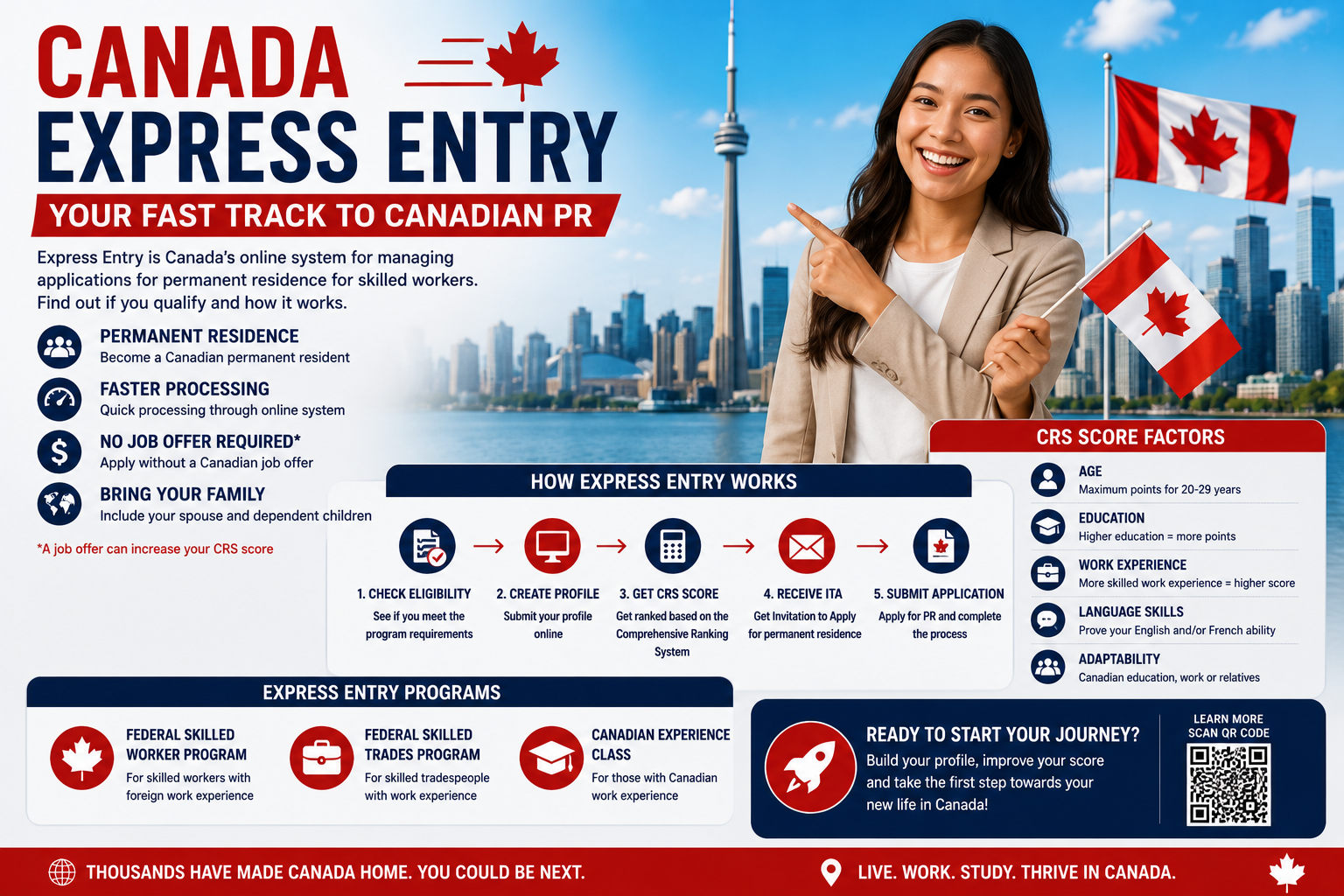
Instead, Express Entry manages applications for three federal programmes:
- Federal Skilled Worker Program.
- Canadian Experience Class.
- Federal Skilled Trades Program.
Eligible candidates create an Express Entry profile and enter a pool with other candidates.
Canada then uses the Comprehensive Ranking System, commonly called CRS, to rank candidates.
Can You Apply for Express Entry Without a Job Offer?
Yes.
You do not necessarily need a Canadian job offer to qualify for Express Entry.
For example, a job offer is not required under the Canadian Experience Class.
It is also possible to qualify for the Federal Skilled Worker Program without having arranged employment in Canada.
The Federal Skilled Trades Program is different. Applicants under that programme generally need either a qualifying Canadian job offer for at least one year or a Canadian certificate of qualification in their skilled trade.
Does a Canadian Job Offer Give You CRS Points?
Not currently.
This is an important change that applicants should understand.
Canada removed additional CRS points for arranged employment on 25 March 2025.
Before this change, qualifying job offers could provide 50 or 200 additional CRS points depending on the occupation.
Those additional job-offer CRS points are no longer awarded.
However, a valid job offer can still matter for eligibility under certain immigration programmes. Therefore, removing job-offer CRS points does not mean employment offers have become irrelevant to Canadian immigration.
Who Can Use Express Entry?
To create a qualifying Express Entry profile, you must meet the requirements of at least one of the three programmes managed through the system.
The programme most relevant to somebody with professional work experience obtained outside Canada is often the Federal Skilled Worker Program.
Federal Skilled Worker Program
The Federal Skilled Worker Program is designed for skilled workers with qualifying Canadian or foreign work experience.
Your skilled work experience must generally be in an occupation classified within TEER 0, 1, 2 or 3 of Canada’s National Occupational Classification system.
You generally need at least one year of continuous qualifying paid skilled work experience within the previous ten years.
You must also satisfy language and education requirements.
What Is the 67-Point Requirement?
Federal Skilled Worker applicants are assessed against six selection factors.
These include:
- Age.
- Education.
- Work experience.
- English or French language ability.
- Arranged employment where applicable.
- Adaptability.
You generally need at least 67 points out of 100 under this selection system to qualify for the Federal Skilled Worker Program.
Do not confuse these 67 selection points with your CRS score.
They are two different scoring systems.
What Is a CRS Score?
CRS means Comprehensive Ranking System.
After you qualify for an Express Entry programme and enter the pool, Canada assigns your profile a CRS score.
Your CRS score determines how you rank against other candidates.
CRS points can come from several factors, including:
- Age.
- Education.
- English ability.
- French ability.
- Canadian work experience.
- Foreign work experience.
- Your spouse’s qualifications where applicable.
- Canadian education.
- French-language ability.
- A brother or sister living in Canada who meets the applicable requirements.
- Provincial or territorial nomination.
The higher your score, the stronger your position can be in invitation rounds for which you qualify.
What CRS Score Do You Need?
There is no single permanent CRS score that guarantees an Invitation to Apply.
IRCC conducts different types of invitation rounds, and the cut-off can change from one draw to another.
The required score depends on factors including the type of draw, number of invitations issued and scores of candidates in the pool.
Instead of relying on an old CRS cut-off found online, check Canada’s latest official invitation rounds.
How Does Age Affect Your CRS Score?
Age is an important CRS factor.
Under the current CRS system, candidates without an accompanying spouse can receive the maximum age points between ages 20 and 29.
Age points gradually decrease after age 29.
This does not mean older applicants cannot qualify for permanent residence. It means they may need to strengthen other areas of their profile.
How Important Is Your Language Score?
Language ability can have a major impact on your Express Entry ranking.
Canada uses Canadian Language Benchmark levels to assess English ability and Niveaux de compétence linguistique canadiens for French.
For the Federal Skilled Worker Program, the minimum language requirement is generally CLB 7 in all four abilities:
- Listening.
- Speaking.
- Reading.
- Writing.
Meeting the minimum makes you potentially eligible, but stronger language results can significantly improve your CRS score.
Which English Tests Does Express Entry Accept?
IRCC accepts approved language tests rather than any general English examination.
Approved English tests currently include:
- IELTS General Training.
- CELPIP-General.
- PTE Core.
For French, approved examinations include TEF Canada and TCF Canada.
Make sure you take the correct version of the examination. For example, IELTS Academic is not the IELTS test used for Express Entry immigration purposes.
Can French Improve Your Chances?
Yes.
Strong French-language ability can provide additional CRS points.
Canada also conducts category-based invitation rounds for candidates with strong French-language proficiency.
For the current French-language category, candidates need French test results showing at least NCLC 7 in all four language abilities, in addition to meeting the other applicable requirements.
Learning French can therefore be particularly valuable for some Express Entry candidates.
What Is an Educational Credential Assessment?
If your education was completed outside Canada and you want to use it for Federal Skilled Worker eligibility or claim education points, you generally need an Educational Credential Assessment.
This is commonly called an ECA.
An ECA determines how your foreign qualification compares with a Canadian educational credential.
The assessment must be completed by an organisation designated by IRCC for immigration purposes.
Does a Master’s Degree Give More CRS Points?
Higher recognised educational qualifications can generally provide more CRS points than lower qualifications.
However, simply holding a master’s degree does not guarantee an Invitation to Apply.
Your overall CRS score still depends on the combination of your age, education, language ability, work experience and other applicable factors.
Canadian Experience Class
The Canadian Experience Class, commonly called CEC, is primarily for skilled workers who have obtained qualifying work experience in Canada.
You generally need at least one year of eligible Canadian skilled work experience within the three years before applying.
The work must be in an occupation within TEER 0, 1, 2 or 3.
A Canadian job offer is not required to qualify for the Canadian Experience Class.
Federal Skilled Trades Program
The Federal Skilled Trades Program is designed for workers qualified in eligible skilled trades.
Applicants generally need at least two years of qualifying skilled trade experience within the five years before applying.
Unlike the Federal Skilled Worker Program and Canadian Experience Class, the Federal Skilled Trades Program generally requires either:
- A valid offer of full-time employment for a total period of at least one year, or
- A certificate of qualification in the skilled trade issued by a Canadian provincial, territorial or federal authority.
What Is Category-Based Express Entry?
Canada can conduct category-based invitation rounds targeting candidates with particular skills, occupations or language abilities.
To receive an invitation in one of these rounds, you must first qualify for one of the three Express Entry programmes and enter the Express Entry pool.
You must then satisfy the requirements of the particular category.
Current Express Entry Categories
Canada’s current category-based selection system includes categories for:
- French-language proficiency.
- Healthcare and social services occupations.
- Science, technology, engineering and mathematics occupations.
- Trade occupations.
- Education occupations.
- Transport occupations.
- Physicians with Canadian work experience.
- Senior managers with Canadian work experience.
- Researchers with Canadian work experience.
- Skilled military recruits.
The categories can change as Canada’s economic and labour market priorities change.
Important Change to Occupational Categories
For the renewed occupational categories, including healthcare and social services, STEM, trades and education, Canada increased the required eligible work experience from six months to one year.
The qualifying experience generally needs to have been obtained within the previous three years and can be Canadian or foreign experience for these renewed categories.
Always check the exact occupation list because simply working in healthcare, technology or another broad sector does not automatically make you eligible for a category.
How Can You Improve Your CRS Score?
If your initial CRS score is lower than recent invitation levels, there may be ways to improve your profile.
Options can include:
- Improve your English results: Higher scores can increase both core and skill-transferability points.
- Learn or improve French: Strong French results can provide additional points and potential access to French-language invitation rounds.
- Gain additional skilled work experience: More qualifying experience can improve your profile in some circumstances.
- Complete further education: A higher recognised qualification can potentially increase education points.
- Consider a Provincial Nominee Program: An Express Entry-linked provincial nomination can dramatically improve your ranking.
- Improve your spouse’s profile: Where applicable, your spouse’s education, language ability and Canadian work experience can contribute points.
How Powerful Is a Provincial Nomination?
A nomination through an Express Entry-linked Provincial Nominee Program currently provides 600 additional CRS points.
This can make a major difference to your ranking in the Express Entry pool.
However, each province and territory establishes its own nomination requirements.
You should therefore research provinces where your occupation, skills and settlement intentions align with their immigration programmes.
Can You Get a Provincial Nomination Without a Job Offer?
Potentially, yes.
Some provincial immigration streams can select candidates without requiring a job offer, while others require employment in the province.
Requirements vary and provincial programmes can open, close or change their selection criteria.
Check the specific provincial programme rather than assuming all PNP streams operate the same way.
Do You Need Proof of Funds?
Some Express Entry applicants need to demonstrate sufficient settlement funds.
Federal Skilled Worker and Federal Skilled Trades applicants generally need proof of funds unless they meet an applicable exemption.
Canadian Experience Class applicants do not normally need settlement funds.
The required amount depends on family size and is updated periodically.
Use the current figure published by IRCC when preparing your application.
How to Apply Through Express Entry
A typical application process looks like this:
- Check your eligibility: Determine whether you qualify for at least one Express Entry programme.
- Identify your NOC: Match your work experience to the correct National Occupational Classification.
- Take an approved language test: Complete IELTS General Training, CELPIP-General, PTE Core, TEF Canada or TCF Canada as appropriate.
- Obtain an ECA: Have eligible foreign education assessed where required.
- Prepare your documents: Gather your passport and relevant employment and personal information.
- Create your Express Entry profile: Submit your information through your IRCC secure account.
- Enter the pool: If eligible, you will receive a CRS score.
- Improve your profile where possible: Consider language improvements, provincial nomination or other legitimate options.
- Receive an Invitation to Apply: IRCC may invite you if you qualify for a round and your ranking is high enough.
- Submit your permanent residence application: If invited, you currently have 60 days to submit the complete application.
What Happens After You Receive an Invitation?
Receiving an Invitation to Apply, commonly called an ITA, allows you to submit a full application for Canadian permanent residence.
You will need to provide documents supporting the claims made in your Express Entry profile.
These can include:
- Identity documents.
- Language test results.
- Education documents.
- Educational Credential Assessment where applicable.
- Employment reference letters.
- Police certificates.
- Proof of funds where required.
- Medical examination information.
- Other documents relevant to your circumstances.
The information must be accurate and consistent with your Express Entry profile.
What Should an Employment Reference Letter Show?
Your employment evidence is particularly important because IRCC needs to determine whether your work experience matches the NOC you claimed.
Evidence should clearly establish your employment and duties.
Your actual responsibilities should correspond with the lead statement and a substantial number of the main duties associated with the claimed NOC.
Choosing an NOC simply because its title resembles your job title can cause problems if your actual responsibilities do not match.
Can You Include Your Family?
Yes, eligible family members can generally be included in a permanent residence application.
This can include your spouse or common-law partner and dependent children who meet Canada’s definition of a dependant.
Your family size can also affect requirements such as settlement funds.
Does Express Entry Guarantee Permanent Residence?
No.
Creating an Express Entry profile does not guarantee that you will receive an Invitation to Apply.
Receiving an ITA also does not automatically guarantee permanent residence.
IRCC still assesses whether you meet the immigration programme requirements, whether the information in your profile is accurate and whether you are admissible to Canada.
Common Express Entry Mistakes
- Using the wrong NOC code.
- Confusing the Federal Skilled Worker 67 points with CRS points.
- Taking IELTS Academic instead of IELTS General Training.
- Claiming work experience that cannot be properly documented.
- Assuming a job offer still provides 50 or 200 CRS points.
- Using an old CRS cut-off as a guaranteed target.
- Failing to update an Express Entry profile after circumstances change.
- Submitting inaccurate employment dates.
- Assuming entry into the pool guarantees an invitation.
- Paying somebody who promises a guaranteed ITA or permanent residence.
Frequently Asked Questions
Can I get Canada PR without a job offer?
Yes. A Canadian job offer is not required for the Canadian Experience Class and is not necessarily required for the Federal Skilled Worker Program. You must still satisfy all requirements of the programme through which you apply.
Does a job offer add 50 CRS points?
No. Canada removed additional CRS points for job offers on 25 March 2025. A valid job offer can still matter for eligibility under certain programmes.
What is the maximum CRS score?
The Comprehensive Ranking System has a maximum score of 1,200 points.
Is 67 points enough for Canada PR?
Not by itself. The 67-point threshold relates to Federal Skilled Worker eligibility. After qualifying, you enter the Express Entry pool and receive a separate CRS score used for ranking.
Can I apply from outside Canada?
Yes. Foreign skilled workers who satisfy the Federal Skilled Worker Program or another applicable programme can create an Express Entry profile while living outside Canada.
Can I apply without an immigration agent?
Yes. Applicants can create their own Express Entry profiles and submit their own permanent residence applications. If you choose to use paid immigration representation, make sure the representative is legally authorised to provide Canadian immigration services.
Can French increase my chances?
Yes. Strong French-language ability can provide additional CRS points and can make eligible candidates competitive in French-language category-based invitation rounds.
Final Thoughts on Canada Express Entry
Canada Express Entry remains an important pathway to permanent residence for skilled workers, including many applicants who do not have Canadian job offers.
The key is to first determine which Express Entry programme you qualify for. After that, concentrate on the factors that affect your CRS score, particularly language ability, education, work experience and opportunities for provincial nomination.
Do not assume that you need to pay someone to find you a Canadian job before you can begin. For many Federal Skilled Worker candidates, a job offer is not required, and Canada no longer awards additional CRS points simply for having one.
At the same time, Express Entry rules continue to evolve. Canada’s category-based selections now target specific skills and labour market priorities, so understanding where your occupation and experience fit can be just as important as knowing your overall CRS score.
Disclaimer: Canadian immigration rules, Express Entry categories, CRS criteria, proof-of-funds requirements and invitation thresholds can change. Always verify current requirements with Immigration, Refugees and Citizenship Canada before submitting an application or making financial decisions.