
High-Paying Jobs in Munich, Germany for International Professionals
Munich is one of Germany’s strongest employment markets for skilled professionals. The city is home to major technology companies, automotive manufacturers, financial institutions, universities, research organisations and healthcare employers.
For international professionals, Munich can be particularly attractive because many employers recruit specialist talent internationally. Software engineers, cybersecurity professionals, cloud engineers, data scientists, engineers, healthcare workers, consultants and finance professionals can all find opportunities.
However, salaries and requirements vary considerably by profession and experience.
This guide explains high-paying jobs in Munich, Germany, typical salaries, industries hiring international professionals, visa options, qualifications, living costs and how to improve your chances of finding work.
Why Work in Munich?
Munich has a diverse economy supported by technology, engineering, manufacturing, finance, healthcare and research.
Instead of looking at each sector separately, here is a quick overview:
| Sector | Major Areas of Opportunity | Examples of Roles |
|---|---|---|
| Technology | Cloud, software, AI, cybersecurity | Developers, cloud engineers, security specialists |
| Automotive | EVs, autonomous driving, manufacturing | Automotive and embedded systems engineers |
| Engineering | Mechanical, electrical, industrial | Engineers, technical specialists |
| Finance | Banking, risk, treasury, fintech | Analysts, finance managers |
| Healthcare | Hospitals, rehabilitation, care | Doctors, nurses, healthcare specialists |
| Life Sciences | Biotechnology, pharmaceuticals | Researchers, QA and regulatory specialists |
| Consulting | Strategy, technology, operations | Management and technology consultants |
| Research | Universities and research institutes | Researchers, scientists, lecturers |
Munich is particularly strong in technology and engineering. Employers also continue investing in artificial intelligence, cloud computing, electric vehicles, automation and digital transformation.
High-Paying Jobs in Munich
The amount you can earn depends on your experience, qualifications, employer and responsibilities.
The salary ranges below are based on the ranges presented in the original article and should be treated as general estimates rather than guaranteed salaries.
| Profession | Typical Annual Salary | Important Skills |
|---|---|---|
| Cloud Architect | €95,000 to €150,000+ | AWS, Azure, Kubernetes, Terraform |
| AI Specialist | €90,000 to €145,000 | Machine learning, NLP, computer vision |
| Cybersecurity Specialist | €80,000 to €135,000 | Security engineering, GRC, architecture |
| Software Engineer | €70,000 to €120,000 | Java, Python, C#, Go, APIs |
| Data Scientist | €70,000 to €125,000 | Python, SQL, analytics, machine learning |
| Project Manager | €80,000 to €130,000 | Agile, transformation, programme delivery |
| Automotive Engineer | €70,000 to €115,000 | EVs, batteries, autonomous systems |
| Finance Professional | €75,000 to €140,000 | Risk, treasury, financial planning |
| Management Consultant | €80,000 to €150,000+ | Strategy, transformation, operations |
| Senior Lawyer | €90,000 to €180,000+ | Corporate and specialist legal expertise |
Actual compensation can be higher or lower depending on the organisation, seniority and specialist expertise.
Technology Jobs in Munich
Technology is one of Munich’s strongest employment sectors.
Instead of treating every IT profession separately, the table below shows the main areas employers may recruit for.
| Technology Area | Common Roles | Useful Skills |
|---|---|---|
| Software | Software Engineer, Backend Developer | Java, Python, C#, Go, JavaScript |
| Cloud | Cloud Engineer, Cloud Architect | AWS, Azure, Google Cloud |
| Cybersecurity | Security Analyst, Engineer, Architect | SIEM, security engineering, GRC |
| Data | Data Scientist, Data Engineer | Python, SQL, analytics |
| Artificial Intelligence | AI/ML Engineer | Machine learning, NLP, computer vision |
| DevOps | DevOps Engineer | Kubernetes, Docker, CI/CD |
| Infrastructure | Platform Engineer | Terraform, Infrastructure as Code |
Many multinational companies operate in English. However, German language skills can significantly increase the number of jobs available to you.
Engineering and Automotive Jobs
Munich is internationally recognised for automotive and advanced engineering.
Growth areas include electric vehicles, autonomous systems, robotics, manufacturing technology and industrial automation.
| Profession | Areas of Work |
|---|---|
| Automotive Engineer | EVs, autonomous vehicles, vehicle development |
| Mechanical Engineer | Manufacturing, robotics, machinery |
| Electrical Engineer | Electronics, renewable energy, automation |
| Embedded Systems Engineer | Automotive software and electronic systems |
| Manufacturing Engineer | Production and smart manufacturing |
| Robotics Engineer | Automation and industrial robotics |
| Battery Specialist | Electric mobility and battery technology |
Professionals with experience in modern manufacturing and digital technologies can be particularly attractive to employers.
Finance, Consulting and Business Careers
Munich is not only an engineering and technology centre.
Banks, fintech companies, multinational corporations and consulting firms also employ experienced professionals.
| Area | Common Opportunities |
|---|---|
| Corporate Finance | Financial analysis, planning and reporting |
| Investment | Investment management and analysis |
| Risk | Financial and operational risk |
| Treasury | Cash and liquidity management |
| Fintech | Technology-driven financial services |
| Consulting | Strategy and transformation |
| Operations | Process and organisational improvement |
| Supply Chain | Procurement, logistics and optimisation |
Senior professionals in finance and consulting can earn particularly competitive salaries.
Healthcare and Life Sciences Jobs
Munich also provides opportunities across healthcare, pharmaceuticals and biotechnology.
| Sector | Potential Roles | Important Requirement |
|---|---|---|
| Hospitals | Doctors, nurses, specialists | Qualification recognition may apply |
| Nursing | Nurses, care professionals | Recognition and language requirements |
| Biotechnology | Scientists, researchers | Relevant scientific qualifications |
| Pharmaceuticals | QA, regulatory, clinical research | Specialist experience |
| Laboratories | Laboratory scientists and technicians | Relevant qualifications |
| Healthcare Management | Administrators and managers | Professional experience |
Foreign professionals should check whether their occupation is regulated before applying.
Doctors, nurses and some other professionals may need formal recognition of their overseas qualifications.
Salary by Experience Level
Experience has a major effect on earning potential.
Your original article divides Munich salaries into entry, mid-career, senior and executive levels.
| Career Level | Typical Annual Salary |
|---|---|
| Entry Level | €50,000 to €70,000 |
| Mid Career | €70,000 to €100,000 |
| Senior Professional | €100,000 to €140,000 |
| Executive | €140,000 to €200,000+ |
These are broad estimates. Technology, finance, consulting and specialist engineering positions can fall outside these ranges.
Which Industries Have the Highest Demand?
International applicants should focus on sectors where their experience closely matches employer needs.
| Industry | In-Demand Skills and Roles |
|---|---|
| Information Technology | Cloud, software, DevOps, cybersecurity, AI |
| Automotive | EVs, autonomous driving, embedded systems |
| Engineering | Mechanical, electrical, industrial, civil |
| Healthcare | Nursing, medicine, allied healthcare |
| Pharmaceuticals | Clinical research, QA, regulatory affairs |
| Biotechnology | Research and laboratory sciences |
| Finance | Risk, treasury, fintech, corporate finance |
| Consulting | Strategy, technology and operations |
| Research | Scientists, academics, researchers |
Rather than applying for hundreds of unrelated jobs, identify the industries where your qualifications and experience provide the strongest match.
Visa and Work Options for International Professionals
Getting a job is only part of the relocation process.
International professionals also need the appropriate legal permission to live and work in Germany.
The exact route depends on nationality, qualifications, occupation, salary and employment circumstances.
Germany Work Route Comparison
| Pathway | Job Offer Required? | Generally Suitable For |
|---|---|---|
| EU Blue Card | Yes | Highly qualified professionals meeting applicable requirements |
| Skilled Worker Route | Usually | Qualified professionals and eligible skilled workers |
| Other Employment Routes | Depends | Workers qualifying under another employment category |
| Permanent Residence | Later | Eligible residents who meet long-term requirements |
Immigration requirements can change. Therefore, applicants should verify the current rules before applying.
EU Blue Card
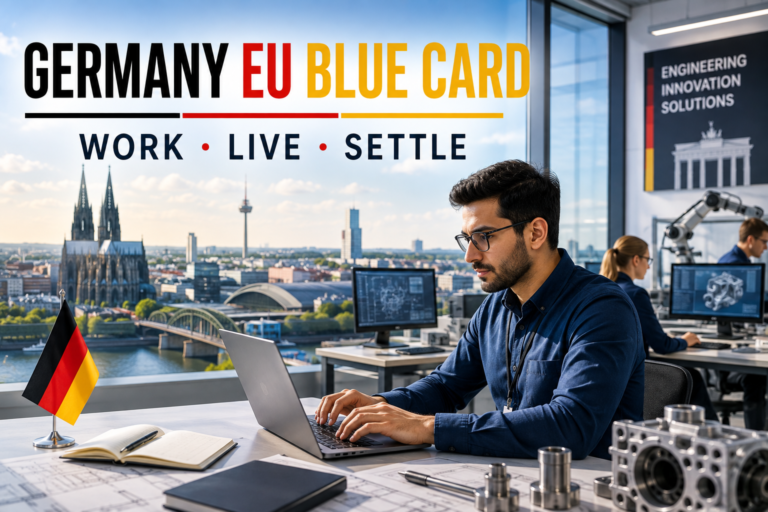
The EU Blue Card is an important route for qualified international professionals.
Applicants generally need a qualifying employment offer and recognised qualifications or other qualifying credentials, depending on the applicable rules.
Salary requirements also apply and can differ for certain occupations.
The EU Blue Card can be particularly relevant to professionals working in:
| Area | Examples |
|---|---|
| Technology | Software, cloud, cybersecurity, AI |
| Engineering | Mechanical, electrical, automotive |
| Healthcare | Eligible highly qualified professionals |
| Science | Researchers and scientific specialists |
| Data | Data scientists and related specialists |
Eligible Blue Card holders may also have pathways towards longer-term residence after meeting the relevant requirements.
Skilled Worker Routes
Germany also has employment routes outside the EU Blue Card framework.
These can potentially cover professionals in engineering, healthcare, IT, manufacturing, research and skilled occupations.
Eligibility depends on the individual immigration route and the applicant’s circumstances.
Does Germany Have Visa Sponsorship?
Germany does not use employer sponsorship in exactly the same way as some other countries.
However, the employer can still play an important role by providing the qualifying employment contract needed for certain work authorisation applications.
Therefore, when searching for jobs, concentrate on employers that are willing to recruit international candidates.
Qualifications German Employers Value
Employers normally look at a combination of education, experience, specialist skills and communication ability.
Degrees and Professional Backgrounds
| Field | Relevant Academic Background |
|---|---|
| Technology | Computer Science, IT |
| Data | Data Science, Mathematics, Statistics |
| Engineering | Mechanical, Electrical, Civil Engineering |
| Finance | Finance, Accounting, Economics |
| Healthcare | Medicine, Nursing, Healthcare |
| Consulting | Business, Economics, specialist disciplines |
| Research | Relevant scientific or technical degree |
A recognised bachelor’s or master’s degree can be important for many professional positions.
However, requirements differ by occupation.
Professional Certifications
Certifications can strengthen your CV, particularly when combined with practical experience.
| Career Area | Useful Certifications |
|---|---|
| Cloud | AWS, Microsoft Azure, Google Cloud |
| Cybersecurity | CISSP, CompTIA Security+ |
| Project Management | PMP, PRINCE2 |
| Agile | Scrum certifications |
| Finance | CFA, ACCA |
| Engineering | Relevant recognised professional credentials |
Your original article identifies these certifications as examples that can strengthen applications.
Do not collect certifications simply for the sake of adding them to your CV. Prioritise qualifications that employers regularly request for your target profession.
Do You Need to Speak German?
Not every job requires fluent German.
Many international technology companies and multinational employers use English as their working language.
However, German can substantially improve your employment prospects.
| German Ability | Potential Benefit |
|---|---|
| No German | Some international and English-speaking roles |
| Basic German | Helpful for daily life |
| B1 | Wider range of workplace opportunities |
| B2 | Stronger professional communication |
| C1+ | Access to roles requiring advanced German |
German is particularly important in professions involving local customers, patients, government organisations or regulated services.
Recognition of Foreign Qualifications
Some occupations require formal recognition before you can practise professionally.
This can include:
| Profession | Recognition May Be Required? |
|---|---|
| Doctors | Yes |
| Nurses | Yes |
| Teachers | Often |
| Certain Engineering Roles | Depends on profession |
| Other Regulated Occupations | Depends on occupation |
Check recognition requirements early. Waiting until you receive a job offer could delay your relocation.
Cost of Living in Munich
High salaries are attractive, but Munich is also an expensive German city.
Housing is likely to be one of your biggest expenses.
The original article estimates a one-bedroom apartment at approximately €1,300 to €2,000 per month and utilities at approximately €180 to €350.
Estimated Monthly Living Costs
| Expense | Estimated Monthly Cost |
|---|---|
| Rent | €1,300 to €2,000 |
| Utilities | €180 to €350 |
| Internet and Mobile | €40 to €80 |
| Transportation | €50 to €80 |
| Groceries | €250 to €450 |
| Miscellaneous | €250 to €500 |
| Estimated Total | €2,070 to €3,460+ |
These are planning estimates rather than guaranteed current prices.
Your actual expenses will depend on location, household size and lifestyle.
Housing Costs
Accommodation can vary considerably.
| Accommodation | Estimated Cost |
|---|---|
| Studio Apartment | €900 to €1,400/month |
| One-Bedroom Apartment | €1,300 to €2,000/month |
| Two-Bedroom Apartment | €1,900 to €3,000+/month |
| Temporary Accommodation | €80 to €220/night |
Finding accommodation before or shortly after relocation can be challenging. Therefore, start researching housing early.
Grocery Budget
| Household | Estimated Monthly Groceries |
|---|---|
| Single Professional | €250 to €450 |
| Couple | €500 to €800 |
| Family | €800 to €1,300+ |
Again, these figures are estimates. Spending varies considerably between households.
How Much Should You Save Before Moving?
Relocation involves much more than buying an airline ticket.
You may need temporary accommodation, a rental deposit, initial rent and money for everyday expenses.
Estimated Relocation Budget
| Expense | Estimated Cost |
|---|---|
| Flights | €600 to €1,500 |
| Temporary Accommodation | €1,500 to €4,000 |
| Rental Deposit and Initial Rent | €3,500 to €7,500 |
| Furniture and Household Items | €1,500 to €5,000 |
| Initial Living Expenses | €2,000 to €4,000 |
| Estimated Total | €9,100 to €22,000+ |
These figures come from the planning estimates in the original article.
You may need considerably less if your employer provides relocation support or accommodation.
How to Find Jobs in Munich
A targeted job search usually works better than sending the same CV to hundreds of employers.
Job Search Methods Compared
| Method | Best Use | Key Tip |
|---|---|---|
| Employer Career Pages | Direct applications | Tailor your application |
| Recruitment Agencies | Specialist vacancies | Choose agencies covering your profession |
| Professional Networking | Hidden opportunities | Build genuine industry connections |
| Recruiter visibility | Keep your profile current | |
| Industry Events | Direct networking | Speak with employers and professionals |
| Professional Associations | Sector contacts | Join groups relevant to your career |
Large multinational employers commonly advertise vacancies directly on their careers websites.
Specialist recruiters can also be useful for technology, engineering, finance, healthcare, consulting and executive positions.
Preparing Your CV for German Employers
Your CV should make it easy for recruiters to understand your experience.
Include:
| CV Section | What to Show |
|---|---|
| Professional Profile | Your specialist area and experience |
| Employment History | Relevant positions and responsibilities |
| Achievements | Measurable results |
| Technical Skills | Tools and technologies |
| Education | Relevant degrees |
| Certifications | Professional credentials |
| Languages | English, German and others |
Avoid sending exactly the same CV for every vacancy.
Instead, adjust the document so your most relevant experience appears clearly for each role.
How to Improve Your Chances
Focus on a combination of technical expertise and employability.
For example:
| Action | Why It Helps |
|---|---|
| Learn German | Expands the number of suitable employers |
| Gain specialist experience | Helps differentiate your profile |
| Earn relevant certifications | Provides evidence of technical knowledge |
| Tailor your CV | Makes your suitability easier to identify |
| Build professional networks | Can expose you to additional opportunities |
| Research employers | Helps you submit stronger applications |
| Check qualification recognition | Prevents delays later |
Employee Benefits in Germany
Salary should not be the only factor you consider when comparing jobs.
Employment packages can also include important benefits.
| Benefit | What It Can Provide |
|---|---|
| Health Insurance | Access to Germany’s healthcare system |
| Paid Annual Leave | Paid time away from work |
| Pension Contributions | Long-term retirement benefits |
| Parental Benefits | Family-related protections |
| Training | Professional development opportunities |
| Language Training | Support for international employees |
| Certifications | Employer-funded professional development in some roles |
Actual benefits depend on the employer, employment agreement and applicable law.
Munich vs Berlin vs Frankfurt
Munich is not the only German city offering strong international career opportunities.
The right city depends on your profession, salary expectations and preferred lifestyle.
| Factor | Munich | Berlin | Frankfurt |
|---|---|---|---|
| Salary Potential | Very High | High | High |
| Housing Costs | Very High | Moderate to High | High |
| Technology | Strong | Very Strong | Strong |
| Automotive | Very Strong | Moderate | Moderate |
| Startups | Strong | Very Strong | Moderate |
| Finance | Strong | Moderate | Very Strong |
| Engineering | Very Strong | Strong | Strong |
| Consulting | Strong | Strong | Very Strong |
| International Employers | Many | Many | Many |
Munich can be particularly attractive for technology, engineering and automotive professionals.
Berlin is well known for startups and digital businesses, while Frankfurt is particularly strong in banking and financial services. Your original article makes the same broad distinction between the three cities.
Common Mistakes International Applicants Make
Several avoidable mistakes can reduce your chances of finding work.
| Mistake | Better Approach |
|---|---|
| Sending a generic CV | Tailor your CV to the vacancy |
| Applying for unrelated jobs | Target roles matching your experience |
| Ignoring German | Learn German where practical |
| Not checking qualification recognition | Research before applying |
| Focusing only on salary | Compare salary with Munich living costs |
| Underestimating housing costs | Prepare a realistic relocation budget |
| Relying only on job boards | Use recruiters and networking too |
| Collecting irrelevant certifications | Prioritise credentials employers request |
Frequently Asked Questions
Is Munich good for international professionals?
Yes. Munich has a strong economy, multinational employers and career opportunities across technology, engineering, automotive, finance, healthcare, consulting and research.
However, competition can be strong, particularly for well-paid positions.
Which jobs pay the most in Munich?
Some of the strongest earning opportunities can be found in cloud architecture, artificial intelligence, cybersecurity, senior software engineering, consulting, finance and specialist professional roles.
Salary depends heavily on experience and employer.
Can I get a job in Munich without speaking German?
Yes, particularly with multinational and technology employers that operate in English.
However, German language skills can significantly increase the number of jobs available to you and make everyday life easier.
Can foreigners work in Munich?
Yes, provided they have the appropriate legal permission to work.
The correct immigration route depends on nationality, qualifications, employment and individual circumstances.
Is Munich expensive?
Yes. Housing is particularly expensive compared with many other German cities.
Therefore, compare the salary offered with expected rent and other living expenses before accepting a position.
Which sectors are best for international workers?
Technology, engineering, automotive, healthcare, research, pharmaceuticals, finance and consulting are among the major sectors covered in this guide.
Do foreign qualifications need to be recognised?
It depends on the profession.
Recognition is particularly important for regulated occupations such as medicine and nursing. Other professions can have different requirements.
Is the EU Blue Card available for jobs in Munich?
Eligible professionals may qualify for the EU Blue Card if they meet the applicable requirements, including those relating to employment, qualifications and salary.
Always check the current official requirements before applying.
Final Thoughts
Munich remains an attractive destination for international professionals seeking competitive salaries and access to major European employers.
Technology professionals can find opportunities across software engineering, cloud computing, cybersecurity, data and artificial intelligence. Meanwhile, Munich’s automotive and engineering industries create opportunities for mechanical, electrical, automotive and manufacturing specialists.
Healthcare, pharmaceuticals, research, finance and consulting provide additional career paths.
However, a high salary should not be considered in isolation. Munich has high housing costs, and international applicants also need to consider work authorisation, qualification recognition, language requirements and relocation expenses.
The strongest approach is to identify roles that genuinely match your experience, prepare a targeted CV, develop relevant skills and research both the employer and immigration requirements carefully.
With the right qualifications and preparation, high-paying jobs in Munich, Germany can provide both strong earning potential and opportunities for long-term professional development.
Disclaimer: Salary figures and living-cost estimates in this article are general planning figures and can change. Visa rules, salary thresholds, qualification requirements and employment conditions can also change. Always verify current requirements and costs before making employment or relocation decisions.