Study in Canada: Student Visa Requirements and How to Apply
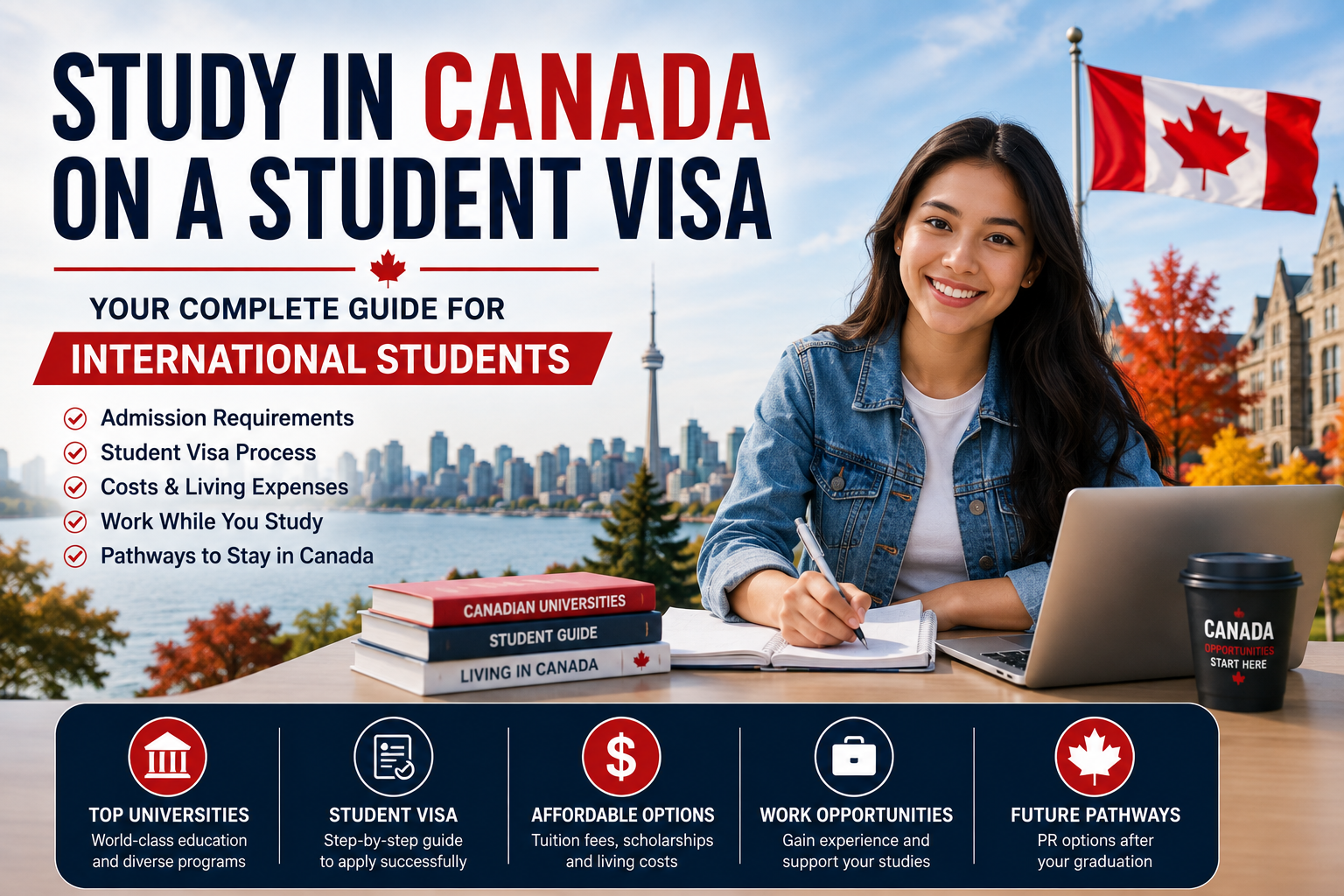
For international students looking for recognised qualifications and overseas experience, choosing to study in Canada can be an attractive option. Canada has universities, colleges and other educational institutions offering programmes across technology, healthcare, engineering, business and many other fields.
However, receiving admission from a Canadian school is only one part of the process. Most international students also need a Canadian study permit before they can begin their studies.
There are important requirements concerning your school, finances, study plans and supporting documents. Some students may also be allowed to work while studying and could qualify for a work permit after graduation.
This guide explains the process from choosing a school to applying for your study permit and understanding your options after completing your course.
What Is a Canada Study Permit?
A study permit is the document that allows an eligible foreign national to study at a designated learning institution in Canada.
Although people commonly search for a “Canada student visa”, the study permit is the main authorisation for studying in Canada.
A visitor visa or electronic travel authorisation may also be issued or required for travel, depending on your nationality and circumstances.
Most importantly, receiving admission from a Canadian school does not automatically mean your study permit will be approved.
Choose a Designated Learning Institution
Before applying for a study permit, you normally need admission to a Designated Learning Institution, commonly called a DLI.
A DLI is a school approved by a Canadian provincial or territorial government to host international students.
Canada maintains an official list of designated learning institutions.
Check that your chosen institution appears on the DLI list before paying significant tuition fees.
This is especially important if you hope to work in Canada after graduation because graduating from a DLI does not automatically mean your programme qualifies for a Post-Graduation Work Permit.
Get Your Letter of Acceptance
After choosing an appropriate school and programme, you need to apply for admission.
If the institution accepts you, it will issue a Letter of Acceptance, commonly known as an LOA.
Your LOA contains important information about your programme, institution and expected period of study.
You will normally need your LOA when submitting your Canadian study permit application.
Do You Need a Provincial Attestation Letter?
Many study permit applicants need a Provincial Attestation Letter or Territorial Attestation Letter, commonly called a PAL or TAL.
This document confirms that the province or territory has allocated a place to you within Canada’s international student system.
Your school normally explains how you can obtain the required PAL or TAL.
There are exemptions.
One particularly important current exemption applies to students entering degree-granting master’s or doctoral programmes at public DLIs. From 1 January 2026, these students do not need a PAL or TAL when applying for a study permit.
If you intend to study in Quebec, different requirements apply and you may need a Quebec Acceptance Certificate, known as a CAQ.
Basic Requirements to Study in Canada
To qualify for a Canadian study permit, you generally need to:
- Be enrolled at a designated learning institution.
- Provide the required acceptance documentation.
- Demonstrate sufficient financial resources.
- Meet applicable health requirements.
- Meet character and admissibility requirements.
- Provide a police certificate if required.
- Satisfy the immigration officer that you will respect the conditions of your temporary stay.
Additional documents can be required depending on your nationality, programme and personal circumstances.
How Much Money Do You Need to Study in Canada?
Financial evidence is one of the most important parts of a study permit application.
You need to demonstrate that you can afford your studies without relying on employment in Canada to fund your basic expenses.
Your available funds should cover:
- Tuition fees.
- Your living expenses.
- Living expenses for accompanying family members.
- Transportation to and from Canada.
If your programme lasts longer than one year, you need to show sufficient resources for your first year and explain how you intend to finance the remainder of your studies.
Current Canada Student Proof of Funds
For study permit applications made on or after 1 September 2025, a single applicant studying outside Quebec currently needs at least CAD $22,895 for first-year living expenses.
This amount does not include tuition fees or transportation costs.
The current living expense requirements are:
- 1 person: CAD $22,895.
- 2 people: CAD $28,502.
- 3 people: CAD $35,040.
- 4 people: CAD $42,543.
- 5 people: CAD $48,252.
- 6 people: CAD $54,420.
- 7 people: CAD $60,589.
For families larger than seven people, an additional amount applies for each extra family member.
These figures are updated periodically, so always check the latest requirement before submitting an application.
What Can You Use as Proof of Funds?
Immigration, Refugees and Citizenship Canada accepts different types of financial evidence depending on your circumstances.
Examples can include:
- Bank statements.
- Evidence of tuition and accommodation payments.
- A Canadian bank account in your name.
- A Guaranteed Investment Certificate from a participating Canadian financial institution.
- Evidence of an education or student loan.
- A bank draft convertible into Canadian dollars.
- Evidence of a scholarship or Canadian-funded educational programme.
- A financial support letter accompanied by evidence showing that the supporter has sufficient funds.
IRCC currently lists bank statements covering the previous four months among the common documents applicants can use.
Simply depositing a large amount shortly before applying without being able to explain its source can make your financial circumstances less clear. Your financial documents should provide a credible picture of how your education will be funded.
How Much Does It Cost to Study in Canada?
There is no single tuition fee for international students in Canada.
Your cost depends on your institution, programme, qualification level and province.
For example, programmes in business, engineering, computing and healthcare can have very different tuition fees.
You should therefore calculate your budget using the actual tuition shown by your chosen institution rather than relying on a general Canadian average.
Remember to budget for more than tuition. Accommodation, food, transport, textbooks, insurance, clothing and other personal expenses can significantly increase the total cost.
How to Apply for a Canada Study Permit
Once you have the necessary documents, the process generally involves the following steps:
- Choose your programme: Find a programme that fits your academic background and career plans.
- Check the institution: Confirm that it is a designated learning institution.
- Check PGWP eligibility: If working after graduation matters to you, verify the eligibility of the institution and programme before accepting admission.
- Apply for admission: Submit the required academic and supporting documents to the institution.
- Receive your LOA: Obtain your official Letter of Acceptance.
- Obtain your PAL or TAL: Get the required provincial or territorial attestation unless you qualify for an exemption.
- Prepare your finances: Gather evidence covering tuition, living expenses and transportation.
- Prepare your study permit documents: Include your passport and other required evidence.
- Submit your application: Study permit applications are normally submitted online.
- Complete biometrics: Provide fingerprints and a photograph if required.
- Complete a medical examination: This may be required depending on your circumstances.
- Wait for the decision: Do not make irreversible travel plans until you have the necessary immigration approval.
Your Study Plan Matters
Your application should make sense academically and professionally.
You should be able to explain why you selected your programme, why you chose the particular institution and how the qualification relates to your education or career plans.
If you already hold significant qualifications, choosing a programme that appears unrelated or substantially below your previous academic level may require a particularly clear explanation.
There is no magic statement that guarantees approval. The information in your application should be truthful, consistent and supported by your documents.
Can International Students Work in Canada?
Eligible international students can work while studying without obtaining a separate work permit for ordinary on-campus or qualifying off-campus employment.
However, specific conditions apply.
During regular academic terms, eligible students can currently work up to 24 hours per week off campus.
During scheduled academic breaks, eligible students can work unlimited hours off campus if they continue to satisfy the applicable conditions.
You must not begin working before your studies start.
Can You Work More Than 24 Hours?
Not during a regular academic term if you are relying on the standard off-campus student work authorisation.
IRCC states that working more than 24 hours per week during regular academic sessions violates study permit conditions.
This can affect your immigration status and future Canadian immigration applications.
Your studies should remain your primary purpose for being in Canada.
Can You Work Full-Time During School Holidays?
Eligible students can generally work unlimited hours off campus during scheduled breaks such as summer holidays, winter holidays and reading weeks.
You must meet the eligibility conditions before and after the scheduled break.
If your programme does not have scheduled breaks, the normal 24-hour weekly limit continues to apply.
What Is a Post-Graduation Work Permit?
The Post-Graduation Work Permit, commonly called the PGWP, can allow eligible international graduates to work in Canada after completing their studies.
This is one reason choosing the right institution and programme before applying to study in Canada is so important.
Not every Canadian school or programme makes a graduate eligible for a PGWP.
You should verify PGWP eligibility before paying your tuition deposit if post-study employment is important to your plans.
Current PGWP Requirements
PGWP rules have changed significantly in recent years.
General eligibility includes completing an eligible programme at a PGWP-eligible designated learning institution. The programme generally needs to be at least eight months long, with different rules applying to some Quebec programmes.
Language requirements now apply to many PGWP applicants.
Some graduates also need to have completed a programme in an eligible field of study, depending on the type of qualification and when their study permit application was submitted.
This makes it important to check the PGWP status of the specific programme, rather than simply checking whether the school itself is a DLI.
Does Studying in Canada Guarantee Permanent Residence?
No.
Studying in Canada does not automatically give you permanent residence.
Canadian education and qualifying Canadian work experience may later help some graduates become eligible or more competitive for immigration programmes, but permanent residence has separate requirements.
Potential pathways after studying can include Express Entry and Provincial Nominee Programs, depending on your circumstances.
Immigration policies can change between the time you begin your course and the time you graduate, so you should avoid choosing a programme solely because somebody promises that it guarantees permanent residence.
Can Your Spouse Work While You Study?
Canada has tightened the eligibility rules for open work permits for spouses and common-law partners of international students.
Not every international student’s spouse automatically qualifies for an open work permit.
Eligibility depends on factors including the principal student’s programme and current immigration rules.
If bringing a spouse is important to your plans, check the current IRCC requirements before selecting your programme or paying tuition.
Common Canada Study Permit Mistakes
- Choosing a school without confirming its DLI status.
- Assuming every DLI programme qualifies for a PGWP.
- Submitting insufficient financial evidence.
- Ignoring the PAL or TAL requirement where it applies.
- Using an unclear or inconsistent study plan.
- Submitting documents containing conflicting information.
- Assuming part-time work will pay all your tuition and living expenses.
- Choosing a programme solely because an agent promises permanent residence.
- Failing to check current PGWP requirements before enrolling.
- Providing false or altered documents.
How to Choose the Right Canadian Programme
Do not choose a programme simply because it appears cheap or because an agent recommends it.
Consider:
- Your previous education.
- Your professional experience.
- Your long-term career objectives.
- The institution’s reputation.
- Programme content.
- Total tuition costs.
- Cost of living in the city.
- Professional accreditation where relevant.
- PGWP eligibility if this matters to you.
A programme that logically builds on your existing education or professional experience can also make your overall study plan easier to explain.
Frequently Asked Questions
How much money do I need to study in Canada?
For applications submitted on or after 1 September 2025, one applicant studying outside Quebec currently needs CAD $22,895 for first-year living expenses, excluding tuition and transportation. You must also demonstrate that you can pay your tuition and travel costs.
Can I work while studying in Canada?
Eligible students can currently work up to 24 hours per week off campus during regular academic terms and may work unlimited hours during scheduled breaks, provided they continue to meet the applicable conditions.
Do I need IELTS to study in Canada?
Your school’s admission language requirements are separate from immigration requirements. Some institutions accept different English or French tests, while certain students may qualify through other evidence. Check the requirements of your specific institution and programme.
Does every Canadian university qualify for a PGWP?
No. You need to check both the institution and your specific programme against the current PGWP eligibility requirements.
Can studying in Canada lead to permanent residence?
Potentially, but it is not guaranteed. Some graduates later qualify for economic immigration programmes based on factors such as education, Canadian work experience, language ability and provincial nomination.
Do master’s students need a PAL?
From 1 January 2026, students applying to degree-granting master’s or doctoral programmes at public designated learning institutions are exempt from the PAL or TAL requirement. Other applicants should check whether an exemption applies to them.
Final Thoughts on Studying in Canada
Choosing to study in Canada can provide international students with access to Canadian education and, for eligible students, opportunities to gain work experience during and after their studies.
However, the decision should begin with careful programme selection. Check that your institution is designated, determine whether your programme is PGWP eligible if post-graduation work matters to you, calculate the full cost and understand the current study permit requirements before paying substantial fees.
The strongest approach is to treat admission, immigration and post-graduation plans as connected but separate stages. Admission does not guarantee a study permit, a study permit does not guarantee a PGWP, and Canadian education does not automatically guarantee permanent residence.
Disclaimer: Canadian study permit rules, financial requirements, student work conditions and PGWP eligibility can change. Always verify the current requirements with Immigration, Refugees and Citizenship Canada before applying or making financial commitments.