USA Visa Sponsorship Jobs 2026: High-Paying Careers
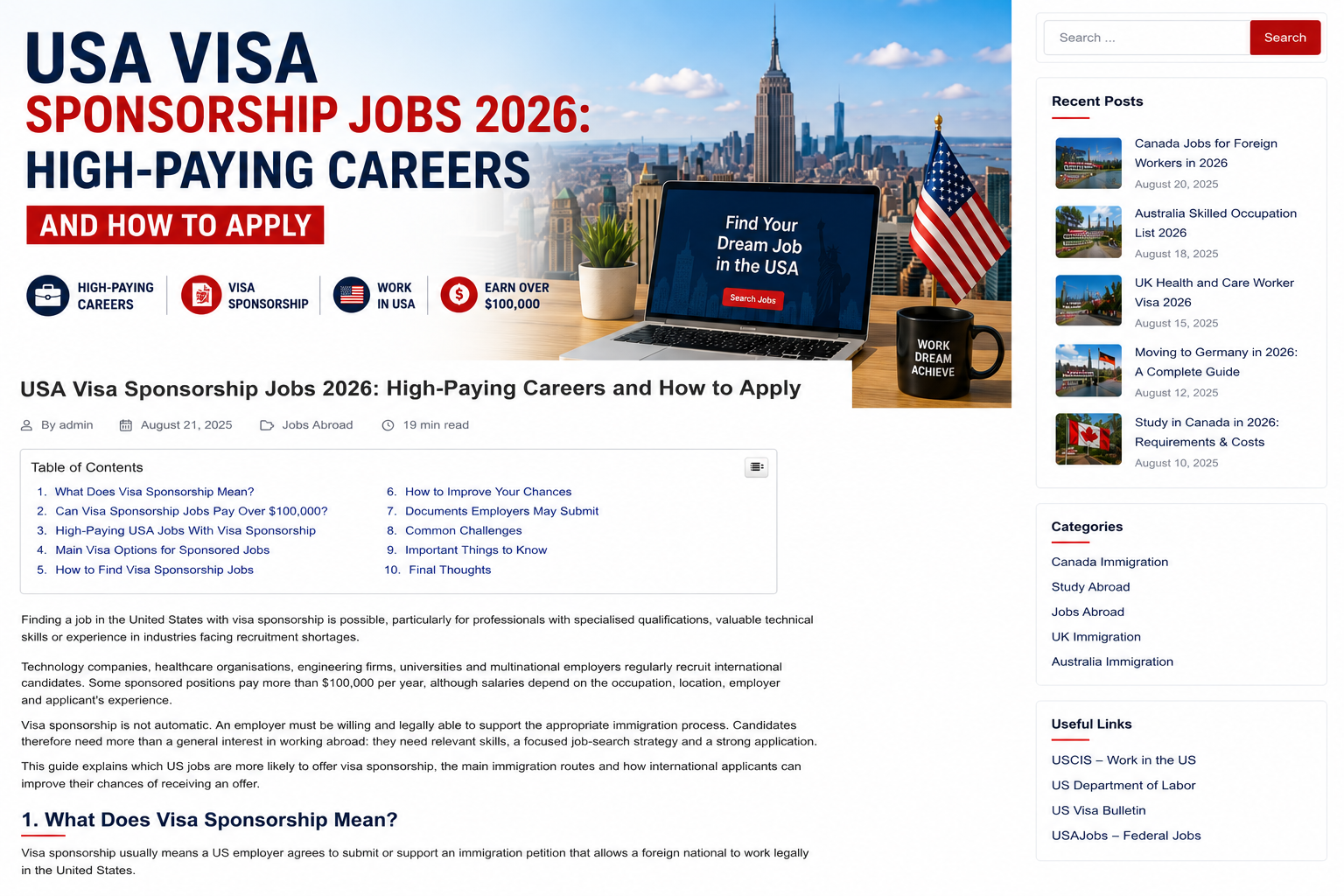
USA visa sponsorship jobs 2026 remain an option for international professionals with specialised qualifications, valuable experience or skills that US employers need. Opportunities can exist across technology, healthcare, engineering, finance, research and other professional fields.
However, visa sponsorship is not automatic. A US employer must be willing and legally able to support the appropriate immigration process, and the worker must qualify for the relevant visa or employment-based immigration category.
This guide explains which careers may offer sponsorship, the main US employment visa routes and practical ways international applicants can search for genuine opportunities.
What Are USA Visa Sponsorship Jobs?
Visa sponsorship generally means a US employer supports or submits an immigration petition that allows an eligible foreign national to work legally in the United States.
The process varies according to the immigration category. For example, an employer seeking an H-1B worker generally needs a certified Labor Condition Application from the US Department of Labor before submitting the relevant petition to US Citizenship and Immigration Services.
Sponsorship does not guarantee approval. USCIS, the US Department of State and other relevant authorities determine whether the immigration requirements have been satisfied.
High-Paying USA Visa Sponsorship Jobs 2026
Some US occupations can pay more than $100,000 annually, but applicants should not treat this as a guaranteed sponsorship salary. Pay varies considerably by occupation, employer, experience and location.
For H-1B employment, the Department of Labor requires employers to pay at least the higher of the actual wage paid to comparable employees or the prevailing wage for the occupation in the area of employment.
International applicants with relevant qualifications may find opportunities in the following areas.
Software Engineering and Cloud Technology
Technology remains an important area for international recruitment. Potential positions include software engineer, cloud engineer, DevOps engineer, solutions architect and site reliability engineer.
Experienced professionals can strengthen their applications by demonstrating measurable technical achievements rather than simply listing programming languages or platforms.
Artificial Intelligence and Data
Artificial intelligence, machine learning and data roles can require advanced technical and analytical skills. Relevant jobs include machine learning engineer, data scientist, data engineer, research scientist and artificial intelligence engineer.
Qualifications vary between employers. Research-intensive positions may require advanced academic qualifications, while commercial roles can place greater emphasis on practical experience.
Cybersecurity
Cybersecurity professionals can work across financial services, healthcare, technology, government contractors and other industries.
Potential occupations include security engineer, cloud security specialist, identity and access management engineer, security analyst and governance, risk and compliance professional.
Healthcare
US healthcare employers also recruit internationally for certain positions. Opportunities can exist for registered nurses, physicians, physical therapists, medical technologists and other qualified healthcare professionals.
Healthcare is highly regulated. International candidates may need credential evaluations, examinations and state licensing before they can practise, even when an employer is willing to provide immigration support.
Engineering and Scientific Research
Civil, mechanical, electrical, chemical, aerospace and manufacturing engineers may find opportunities with employers seeking specialised expertise.
Universities, laboratories and research organisations also recruit international academics, scientists and researchers. Some qualifying higher education and research employers can file H-1B petitions that are exempt from the standard annual numerical cap.
Main US Visa Routes for Sponsored Workers
There is no universal “US sponsorship visa”. Different immigration categories serve different workers and employment situations.
H-1B Specialty Occupation
The H-1B classification covers qualifying specialty occupations requiring highly specialised knowledge and normally at least a bachelor’s degree or equivalent preparation in a directly related speciality.
The prospective employer generally files a Labor Condition Application with the Department of Labor and then submits Form I-129 to USCIS.
Many private-sector H-1B petitions are subject to an annual numerical limit and registration selection process. A job offer therefore does not guarantee that a cap-subject applicant can obtain H-1B status.
Applicants should use the official USCIS H-1B information when checking current requirements.
L-1 Intracompany Transfer
The L-1 route can apply to certain employees transferring from an overseas organisation to a related US office.
L-1A primarily covers qualifying managers and executives, while L-1B applies to certain employees with specialised knowledge.
This can make employment with a multinational organisation outside the United States another potential route for professionals whose employer later needs them in its US operations.
O-1 Extraordinary Ability
The O-1 category is intended for people who can demonstrate extraordinary ability or achievement in qualifying fields.
It is a much higher evidential standard than simply being experienced in your profession. Applicants need substantial evidence demonstrating the required level of achievement.
EB-2 and EB-3 Green Card Routes
Some employers also sponsor workers for permanent residence rather than only temporary employment.
EB-2 can cover professionals holding advanced degrees and people with exceptional ability. Certain eligible applicants can seek a National Interest Waiver, which can remove the normal job offer and labour certification requirements.
EB-3 covers qualifying skilled workers, professionals and certain other workers. These employment-based categories can lead to permanent residence, but visa availability and processing periods vary.
Read the USCIS permanent worker guidance for the official employment-based classifications.
How to Find US Employers Offering Visa Sponsorship
International applicants should use a targeted approach rather than sending the same application to hundreds of employers.
- Identify suitable occupations: Concentrate on positions closely matching your qualifications and experience.
- Research employers: Look for organisations with international operations or a genuine history of employing foreign professionals.
- Read the vacancy carefully: Some advertisements clearly state whether sponsorship is available.
- Check official careers pages: Confirm that vacancies advertised elsewhere genuinely exist on the employer’s website.
- Tailor your application: Show how your skills solve the particular employer’s problem.
- Answer sponsorship questions honestly: If asked whether you need immigration sponsorship, provide accurate information.
The US Department of Labor publishes foreign labour certification performance data, which can help applicants research employment immigration activity. Previous sponsorship does not mean an employer will sponsor every vacancy.
How to Prepare a Strong US Job Application
A US résumé should normally focus on skills, experience and measurable achievements. Avoid filling it with unnecessary personal information.
Instead of simply writing that you managed cloud infrastructure, for example, explain what improved because of your work, such as reduced costs, increased availability or faster incident resolution.
Your application should clearly demonstrate relevant qualifications, technical skills, professional licences where required, industry experience and achievements that relate directly to the vacancy.
Software professionals can also benefit from appropriate portfolios or coding projects. Researchers can highlight publications and research achievements, while designers can present relevant professional portfolios.
Understand H-1B Wage Protections
Foreign workers should understand that H-1B employment includes wage protections.
The US Department of Labor states that the required wage must be the higher of the employer’s actual wage for similarly qualified workers performing the same job or the prevailing wage for that occupation in the relevant geographic area.
The employer must also provide working conditions that do not adversely affect similarly employed workers and offer benefits on the same basis as comparable US employees.
You can review the Department of Labor Labor Condition Application process for current information.
Visa Sponsorship Scams to Avoid
International job seekers should verify employers before providing sensitive information or paying immigration-related expenses.
Warning signs can include:
- Guaranteed visa approval.
- A supposed employer demanding payment for a job offer.
- No genuine recruitment or interview process.
- Unrealistically high salaries for basic positions.
- Emails that do not match the employer’s genuine contact details.
- Requests for banking information before the employer has been verified.
- Pressure to provide false qualifications or employment history.
Check the vacancy directly through the employer’s official website. No employer or recruiter can guarantee that USCIS or a US consular officer will approve an immigration application.
Final Thoughts on USA Visa Sponsorship Jobs 2026
USA visa sponsorship jobs 2026 can provide legitimate opportunities for international professionals, particularly where candidates have specialised qualifications or experience that employers genuinely need.
Technology, artificial intelligence, cybersecurity, healthcare, engineering, finance and research are among the areas worth exploring, but sponsorship depends on the employer, position and immigration category.
Build a strong professional profile, target genuine vacancies and verify the correct immigration route before accepting an offer. A high salary or recognised employer does not remove the need to satisfy US immigration requirements.