Atlantic Canada Jobs 2026: How to Apply
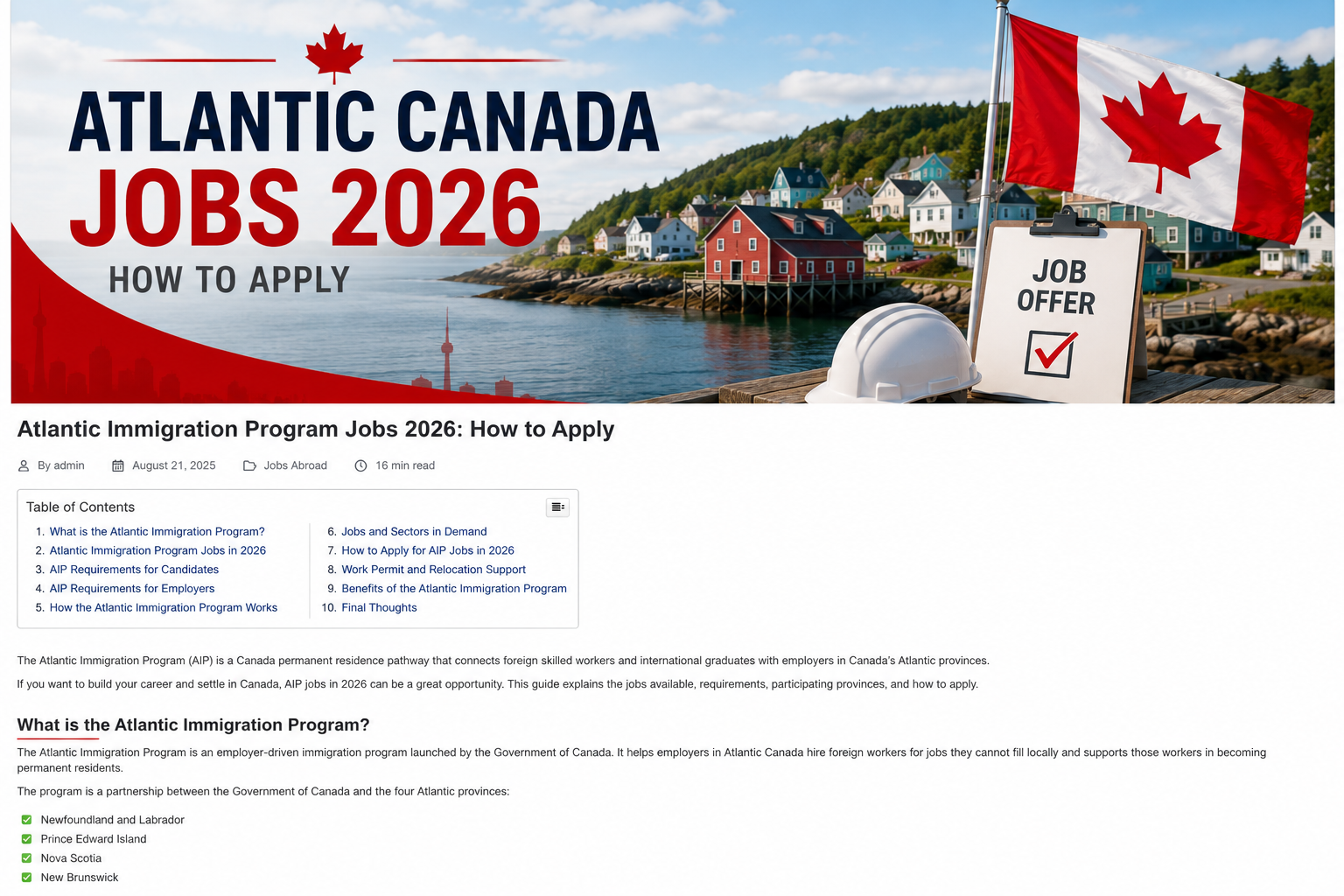
If you are searching for Atlantic Canada jobs 2026, the Atlantic Immigration Program may be worth understanding. It allows designated employers in four Canadian provinces to recruit eligible skilled foreign workers and international graduates for positions they have been unable to fill locally.
More importantly, the Atlantic Immigration Program, commonly called AIP, is a pathway to Canadian permanent residence. Candidates can be living overseas or already in Canada when they receive a qualifying job offer.
This guide explains where to look for opportunities, which employers can participate, the eligibility requirements and how the application process works in 2026.
What Is the Atlantic Immigration Program?
The Atlantic Immigration Program is an employer-driven permanent residence programme covering four provinces:
- New Brunswick
- Newfoundland and Labrador
- Nova Scotia
- Prince Edward Island
According to Immigration, Refugees and Citizenship Canada’s Atlantic Immigration Program guidance, the programme is available to qualifying skilled foreign workers and recent graduates of recognised post-secondary institutions in Atlantic Canada.
The programme is different from Express Entry. You need a qualifying job offer from an employer specifically designated by one of the four Atlantic provinces.
How to Find Atlantic Canada Jobs in 2026
The most important thing to understand is that not every employer in Atlantic Canada can hire a candidate through AIP.
Employers must first receive designation from the provincial government where the worker will be employed. Each province manages its own designation process and information about participating employers.
When searching for opportunities, check the official provincial immigration websites for:
- New Brunswick designated employers
- Nova Scotia designated employers
- Prince Edward Island designated employers
- Newfoundland and Labrador designated employers
You can access the provincial resources from the Government of Canada AIP job offer page.
Being on a designated employer list does not mean a company currently has vacancies. Applicants should visit the employer’s official careers page and look for positions matching their genuine qualifications and experience.
What Type of Job Offer Do You Need?
A qualifying AIP job offer must be full-time, which means at least 30 hours per week, and non-seasonal.
The required duration depends on the Training, Education, Experience and Responsibilities category, commonly known as TEER, of the occupation.
For jobs classified as TEER 0, 1, 2 or 3, the employment must last for at least one year from the date you become a permanent resident.
For TEER 4 occupations, the job offer must be permanent with no specified end date.
The position must also be one you are qualified and able to perform. Your previous work experience generally needs to be at the appropriate TEER level in relation to the job being offered.
Who Can Apply for the Atlantic Immigration Program?
A job offer alone is not enough. Applicants must satisfy the programme’s immigration requirements.
You generally need:
- A valid job offer from a designated Atlantic Canadian employer.
- Qualifying work experience, unless you meet the international graduate exemption.
- The required level of education.
- An approved English or French language test.
- Sufficient settlement funds, unless exempt.
- A settlement plan from an approved service provider.
- Provincial endorsement of the job offer.
How Much Work Experience Do You Need?
Most skilled worker applicants need at least 1,560 hours of qualifying work experience during the previous five years. This is equivalent to working approximately 30 hours per week for one year.
The experience must be relevant to the occupation and satisfy the programme requirements.
However, certain international graduates from recognised institutions in Atlantic Canada do not need to meet the work experience requirement.
To qualify for this exemption, the programme of study must generally have lasted at least two years, and the graduate must meet requirements relating to full-time study, residence in Atlantic Canada and immigration status.
Language Requirements for Atlantic Canada Jobs 2026
You need an approved English or French language test even if you already speak the language well.
For a job offer classified as TEER 0, 1, 2 or 3, you need at least Canadian Language Benchmark 5 or NCLC 5 for French.
For a TEER 4 job offer, the minimum is CLB or NCLC 4.
Accepted English tests include IELTS General Training, CELPIP-General and PTE Core. Accepted French tests include TEF Canada and TCF Canada.
Your results must be less than two years old when you apply. Check the official AIP language requirements for the scores corresponding to each CLB level.
Education Requirements
Your minimum education requirement depends on the TEER level of the job offer.
For TEER 0 or 1 jobs, you generally need at least a Canadian one-year post-secondary credential or an equivalent foreign qualification.
For TEER 2, 3 or 4 jobs, you generally need at least a Canadian high school diploma or equivalent. Individual occupations can require higher qualifications.
If you studied outside Canada, you normally need an Educational Credential Assessment to demonstrate the Canadian equivalency of your qualification.
Regulated professions may also require professional licensing or certification before you can work in the occupation.
How Much Proof of Funds Do You Need?
If you are not already living and working legally in Canada with a valid work permit, you normally need to demonstrate settlement funds.
The current minimum amounts published by IRCC are:
- 1 family member: CAD $3,815
- 2 family members: CAD $4,750
- 3 family members: CAD $5,840
- 4 family members: CAD $7,090
- 5 family members: CAD $8,042
- 6 family members: CAD $9,070
- 7 family members: CAD $10,098
- Each additional family member: CAD $1,028
You cannot use borrowed money or property equity to satisfy this requirement. IRCC also requires appropriate evidence from your financial institution.
Always check the latest AIP settlement funds before applying because these amounts can be updated.
How the AIP Application Process Works
The process starts with employment rather than directly submitting a permanent residence application.
- Find a designated employer: Search participating employers and genuine vacancies in one of the four Atlantic provinces.
- Receive a qualifying job offer: The employer provides the required employment documentation.
- Check your eligibility: Confirm your work experience, education and language results satisfy AIP requirements.
- Get a settlement plan: After receiving the job offer, complete a needs assessment with an approved settlement service provider. The settlement plan is free.
- Get provincial endorsement: Your employer submits the required information to the province. If approved, you receive a Certificate of Endorsement.
- Apply for permanent residence: Submit your complete AIP permanent residence application to IRCC.
Do not submit the permanent residence application until the job offer has received the required provincial endorsement.
Can You Work While Waiting for Permanent Residence?
Eligible AIP candidates may be able to apply for a temporary work permit while their permanent residence application is being processed.
The AIP temporary work permit is employer-specific and can be valid for up to two years. You need a qualifying offer from a designated employer and a referral letter from the Atlantic province where you will work.
Receiving a work permit does not guarantee approval of your permanent residence application.
How Much Does the AIP Permanent Residence Application Cost?
Canada increased permanent residence fees on 30 April 2026.
The principal applicant under the Atlantic Immigration Program currently pays CAD $990 as the processing fee plus CAD $600 for the right of permanent residence fee, making a total of CAD $1,590.
An accompanying spouse or partner also costs CAD $1,590 including the right of permanent residence fee. The fee for an accompanying dependent child is CAD $270.
Biometrics and third-party expenses, including medical examinations, police certificates, language tests and educational credential assessments, may add to the overall cost.
Avoid Fake Atlantic Canada Job Offers
AIP applicants should be particularly careful about fake designated employers and paid job offers.
Always verify that the employer is designated by the relevant Atlantic province and independently confirm that the vacancy is genuine.
Do not assume that paying an agent guarantees employment, provincial endorsement or permanent residence. No employer or recruiter can guarantee that IRCC will approve your immigration application.
Be particularly cautious if someone asks for large payments for a job offer, refuses to provide verifiable company information or tells you to submit false qualifications or employment history.
Final Thoughts on Atlantic Canada Jobs 2026
Atlantic Canada jobs 2026 can provide eligible foreign workers with more than an employment opportunity. A qualifying offer from a designated employer can form part of a direct pathway towards Canadian permanent residence through the Atlantic Immigration Program.
The best place to start is with the official designated employer information for New Brunswick, Nova Scotia, Prince Edward Island and Newfoundland and Labrador. Search for genuine vacancies that match your skills rather than paying someone to obtain an offer.
Once you receive a qualifying offer, check your language, education, work experience, settlement funds and endorsement requirements carefully before applying.
Disclaimer: Canadian immigration rules, fees, settlement fund requirements and provincial procedures can change. This article provides general information and is not immigration or legal advice. Always confirm current requirements through Immigration, Refugees and Citizenship Canada and the relevant Atlantic provincial government before applying.