Skilled Trades Jobs in Canada for Foreign Workers
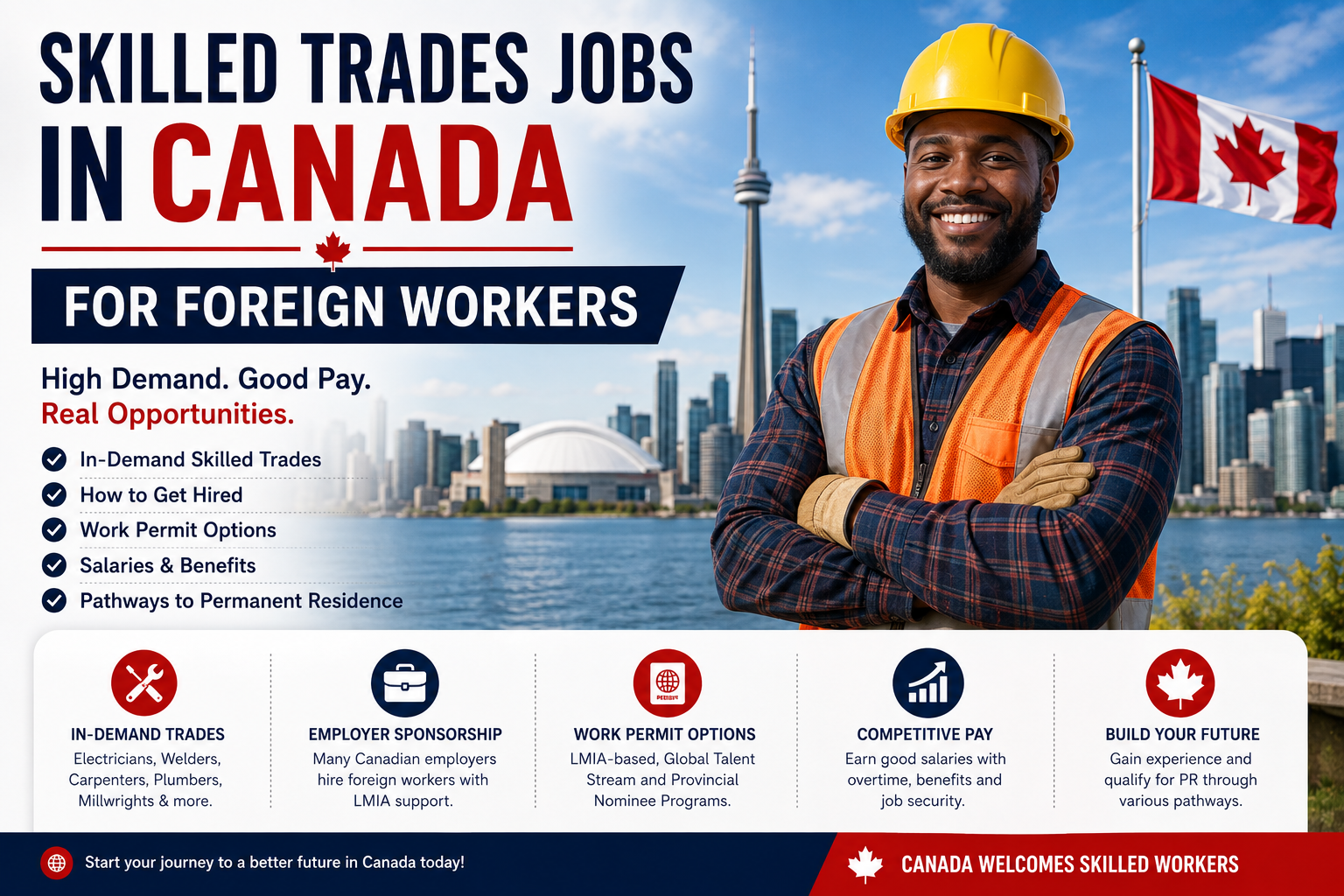
Skilled trades jobs in Canada can provide opportunities for experienced foreign workers in industries such as construction, manufacturing, transportation, maintenance and industrial services.
Canada employs skilled tradespeople across many occupations, including electricians, welders, plumbers, carpenters, industrial mechanics and heavy-duty equipment technicians.
However, being experienced in a trade overseas does not automatically give you permission to work in Canada. Depending on your occupation and province, you may need a Canadian employer, a work permit, provincial trade certification or recognition of your previous training.
This guide explains the skilled trades worth investigating, how foreign workers can search for jobs and the immigration pathways that may be available.
Can Foreign Workers Get Skilled Trades Jobs in Canada?
Yes. Canadian employers can hire eligible foreign workers for skilled trades positions when the relevant employment and immigration requirements are met.
The process depends on your occupation, province and immigration route.
Some foreign workers enter Canada with an employer-specific work permit. Others may eventually qualify for permanent residence through federal or provincial economic immigration programmes.
It is important to treat employment, trade certification and immigration as separate requirements.
Skilled Trades Jobs to Consider in Canada
Canada’s skilled trades workforce covers a wide range of occupations.
Depending on your qualifications and experience, jobs worth investigating can include:
- Electricians.
- Welders.
- Plumbers.
- Carpenters.
- Industrial mechanics and millwrights.
- Heavy-duty equipment mechanics.
- Heating, refrigeration and air-conditioning mechanics.
- Machinists.
- Construction millwrights.
- Sheet metal workers.
- Steamfitters and pipefitters.
- Crane operators.
- Industrial electricians.
- Automotive service technicians.
This does not mean every vacancy in these occupations is available to an overseas applicant. Employers determine their own recruitment requirements, and provincial certification rules can also apply.
Electrician Jobs in Canada
Electricians are employed in residential construction, commercial buildings, manufacturing facilities and industrial environments.
There are also different electrician classifications.
For example, someone working primarily with industrial electrical equipment may have different certification requirements from a construction electrician.
Electrician certification is compulsory in some Canadian provinces and voluntary in others, depending on the specific trade.
Foreign electricians should therefore investigate the requirements in their intended province before assuming their overseas qualification will automatically allow them to work independently.
Welder Jobs in Canada
Welders work across industries including manufacturing, construction, fabrication, energy and industrial maintenance.
Employers can look for experience with particular welding techniques, equipment and materials.
Certification requirements can vary by province and the type of work being performed.
When applying from overseas, clearly describe the welding processes you have professional experience using rather than simply writing “welder” on your CV.
Plumber Jobs in Canada
Plumbers install, maintain and repair piping systems in residential, commercial and industrial properties.
Provincial apprenticeship and certification requirements can apply.
Experienced foreign plumbers may need to have their previous qualifications and professional experience assessed before becoming fully certified in a Canadian province.
Because building codes and professional standards can differ from those in your home country, additional Canadian training or examinations may be required.
Carpenter Jobs in Canada
Carpenters work on residential, commercial and industrial construction projects.
Typical responsibilities can include constructing frameworks, installing building components, interpreting plans and working with different construction materials.
Requirements depend on the employer and province.
Practical experience can be particularly important when applying for these positions, so your CV should explain the projects and types of construction work you have completed.
Industrial Mechanic and Millwright Jobs
Industrial mechanics and construction millwrights install, maintain, troubleshoot and repair industrial machinery.
These skills are used across manufacturing, processing and other industrial environments.
Applicants with experience maintaining complex machinery should clearly identify the equipment and systems they have worked with.
Canadian trade certification requirements should also be checked for the province where the position is located.
Do You Need Canadian Trade Certification?
This depends on the trade and province.
Canada does not have one universal licensing system covering every skilled trade across the entire country.
Trades are generally regulated by provincial and territorial authorities.
A trade can therefore be compulsory in one jurisdiction while operating under different certification arrangements elsewhere.
If certification is compulsory, you normally need to obtain the appropriate certification before independently practising that trade.
What Is the Red Seal Programme?
The Red Seal Programme establishes common standards for designated trades across participating Canadian provinces and territories.
Tradespeople who successfully meet the applicable requirements and pass the Red Seal examination can receive a Red Seal endorsement on their provincial or territorial trade certificate.
The programme supports labour mobility for qualified tradespeople across Canada.
However, having overseas trade experience does not automatically give you a Red Seal.
You first need to satisfy the relevant provincial or territorial requirements to challenge the examination or obtain trade certification.
Can Overseas Trade Experience Be Recognised?
Potentially.
Some provincial authorities have processes that allow experienced tradespeople to demonstrate previous training and work experience.
You may be asked to provide evidence such as:
- Trade qualifications.
- Apprenticeship records.
- Employment letters.
- Detailed job descriptions.
- Evidence of hours worked.
- Professional certificates.
The responsible provincial authority decides whether your experience meets its requirements.
How to Find Skilled Trades Jobs in Canada
If you are applying from outside Canada, begin by identifying your occupation and the provinces where your experience is relevant.
A practical approach is:
- Identify your Canadian occupation: Determine how your trade is classified under Canada’s National Occupational Classification.
- Check provincial certification: Find out whether your trade is regulated or compulsory in your preferred province.
- Prepare evidence of experience: Gather certificates, employment records and apprenticeship evidence.
- Prepare a Canadian-style CV: Focus on practical skills and relevant experience.
- Search genuine vacancies: Use employer career pages and Canada’s Job Bank.
- Check international recruitment: Determine whether the employer accepts applications from candidates outside Canada.
- Apply directly: Follow the employer’s official recruitment procedure whenever possible.
How Should You Prepare Your CV?
A trades CV should clearly demonstrate what you can actually do.
Include information such as:
- Your trade and specialisation.
- Years of professional experience.
- Apprenticeship or vocational training.
- Trade certificates.
- Machinery and equipment experience.
- Construction or industrial environments you have worked in.
- Health and safety training.
- Relevant projects.
Avoid filling your CV with generic statements. Employers should be able to understand your practical capabilities quickly.
Can Canadian Employers Hire Foreign Tradespeople?
Yes, provided the applicable immigration requirements are met.
For some positions, an employer may need a Labour Market Impact Assessment, commonly called an LMIA, before the foreign worker can apply for an employer-specific work permit.
There are also situations where employment can be LMIA-exempt.
The appropriate route depends on the worker, employer and circumstances.
What Is an LMIA?
A Labour Market Impact Assessment is used in many temporary foreign worker situations to assess the effect of hiring a foreign national on Canada’s labour market.
Where an LMIA is required, the Canadian employer applies for it.
The foreign worker does not independently purchase an LMIA.
If a positive LMIA is issued, the employer can provide the necessary employment documentation for the worker’s work permit application.
Approval of an LMIA does not automatically guarantee approval of the worker’s immigration application.
How Does the Work Permit Process Work?
A typical employer-specific process where an LMIA is required can involve:
- Finding a genuine Canadian employer.
- Receiving a written employment offer.
- The employer completing the LMIA process.
- Receiving the relevant employer documentation.
- Submitting your Canadian work permit application.
- Providing biometrics where required.
- Completing a medical examination if required.
- Submitting additional documents requested by immigration authorities.
- Receiving a decision on the work permit application.
You should not assume that receiving an employment offer alone gives you permission to travel to Canada and begin working.
Can Skilled Trades Lead to Permanent Residence?
Potentially, yes.
Canada has economic immigration pathways that can be relevant to experienced tradespeople.
One important programme is the Federal Skilled Trades Program, which is managed through Express Entry.
Provincial Nominee Programs can also provide opportunities for skilled workers whose occupations meet provincial labour market needs.
What Is the Federal Skilled Trades Program?
The Federal Skilled Trades Program is designed for skilled workers who want to become permanent residents based on qualifications in an eligible skilled trade.
Applicants generally need at least two years of full-time work experience, or an equivalent amount of part-time experience, in an eligible skilled trade within the five years before applying.
You must also meet the required language levels and satisfy the occupational requirements for your trade.
Another important requirement is that you generally need either:
- A valid full-time job offer for a total period of at least one year, or
- A Canadian certificate of qualification in your skilled trade issued by the appropriate federal, provincial or territorial authority.
Meeting the minimum requirements allows you to qualify for the programme, but it does not guarantee an invitation to apply for permanent residence through Express Entry.
Do You Need a University Degree?
The Federal Skilled Trades Program does not have a formal education requirement.
This is one reason it can be relevant to experienced tradespeople whose professional skills were developed through vocational training, apprenticeships and practical work rather than university education.
However, education can still affect your Express Entry ranking.
If you have foreign education and want to claim points for it, you generally need an Educational Credential Assessment.
Language Requirements for Skilled Trades
Federal Skilled Trades applicants must meet minimum language requirements.
The current minimum is Canadian Language Benchmark 5 for speaking and listening and Canadian Language Benchmark 4 for reading and writing.
You need to take an approved language examination.
Accepted tests currently include IELTS General Training, CELPIP-General and PTE Core for English, as well as TEF Canada and TCF Canada for French.
Higher language results can improve your Express Entry score.
What Is a Certificate of Qualification?
A certificate of qualification demonstrates that a person is qualified to practise a particular skilled trade in Canada.
It is issued by the authority responsible for trades in the applicable province, territory or, in limited cases, federally.
Obtaining one from overseas can be challenging because the responsible authority may need to assess your training and professional experience.
Some authorities may also require you to travel to the province or territory to complete an assessment or examination.
Provincial Nominee Programs for Tradespeople
Provincial Nominee Programs, commonly called PNPs, allow provinces and territories to nominate foreign nationals who meet their economic and labour market requirements.
Skilled trades can be particularly relevant where a province needs workers for construction, manufacturing, infrastructure or industrial projects.
Requirements vary significantly between provinces.
Some pathways require an existing job offer, while others operate under different selection criteria.
Check the current requirements of the province rather than assuming one PNP rule applies throughout Canada.
Which Province Should You Target?
There is no single best Canadian province for every tradesperson.
Your choice should depend on:
- Demand for your specific trade.
- Provincial certification requirements.
- Available vacancies.
- Typical wages.
- Cost of living.
- Immigration pathways.
- Your long-term settlement plans.
For example, the employment market for an industrial mechanic may differ considerably from that of a residential carpenter.
Can You Apply for Jobs From Outside Canada?
Yes. Foreign workers can apply for Canadian vacancies from overseas.
However, read each vacancy carefully.
Some employers only accept applicants who already have legal permission to work in Canada, while others may consider qualified international candidates.
Canada’s Job Bank provides information that can help job seekers identify vacancies and understand the Canadian labour market.
Watch Out for Fake Skilled Trades Jobs
Overseas workers should be cautious when responding to recruitment advertisements.
Warning signs can include:
- A guaranteed Canadian visa.
- A guaranteed LMIA.
- A job without any proper interview or assessment.
- Requests to pay large sums for an LMIA.
- Promises of immediate permanent residence.
- Unrealistically high salaries.
- Recruitment emails that cannot be connected to the real employer.
- Pressure to send money immediately.
Verify the employer independently before sending money or sensitive personal documents.
Frequently Asked Questions
Can foreigners get skilled trades jobs in Canada?
Yes. Qualified foreign workers can potentially obtain skilled trades employment in Canada if they satisfy the employer, immigration and applicable provincial trade requirements.
Which trades can foreign workers consider?
Opportunities can exist for electricians, welders, plumbers, carpenters, industrial mechanics, heavy-duty equipment technicians and other qualified tradespeople. Availability depends on the labour market and province.
Do I need a degree?
Not necessarily. Many skilled trades rely on vocational training, apprenticeships and professional experience. The Federal Skilled Trades Program itself does not have a formal education requirement.
Can I apply for jobs while outside Canada?
Yes. You can apply from overseas, but employers decide whether they are prepared to recruit foreign workers.
Can a skilled trade lead to permanent residence?
Potentially. Eligible workers may qualify through programmes such as the Federal Skilled Trades Program or certain Provincial Nominee Programs, depending on their circumstances.
Do I need a job offer for the Federal Skilled Trades Program?
You generally need either a valid qualifying job offer for at least one year or a Canadian certificate of qualification in your skilled trade. Other programme requirements also apply.
Final Thoughts on Skilled Trades Jobs in Canada
Skilled trades jobs in Canada can provide genuine opportunities for experienced foreign workers, particularly those with strong practical skills and documented professional experience.
However, the process involves more than finding an online vacancy. You need to understand your trade’s provincial certification requirements, determine whether an employer can legally hire you and identify the correct work permit or permanent residence pathway.
Start by identifying your Canadian occupational classification and checking whether your trade is regulated in the province where you want to work. You can then target genuine employers with vacancies matching your experience.
Disclaimer: Canadian immigration programmes, trade certification requirements and employment rules can change. Always verify current requirements through Immigration, Refugees and Citizenship Canada and the relevant provincial or territorial trade authority before applying.