EB-3 Nursing Jobs in the USA for Foreign Nurses
EB-3 nursing jobs in the USA can provide qualified foreign registered nurses with an employment-based pathway to live and work permanently in the United States.
Unlike a temporary work visa, an EB-3 case can ultimately result in lawful permanent residence, commonly known as a green card, if the nurse, employer and immigration petition satisfy all applicable requirements and an immigrant visa becomes available.
Professional nurses also have an important advantage under US immigration rules. They are included in Schedule A, a category covering occupations for which the US Department of Labor has already determined there are insufficient US workers who are able, willing, qualified and available.
However, this does not mean that every foreign nurse automatically qualifies for an EB-3 green card. You still need a genuine qualifying US employer, appropriate nursing credentials and successful completion of the immigration process.
What Is the EB-3 Visa?
EB-3 is the third preference employment-based immigrant visa category.
It covers three broad groups:
- Skilled workers.
- Professionals.
- Other workers.
A professional registered nurse sponsored for a permanent nursing position can potentially qualify under the employment-based third preference system.
Because EB-3 is an immigrant category, successful applicants can become US permanent residents rather than simply receiving temporary permission to work.
Why Are Registered Nurses Different Under Schedule A?
Most employment-based permanent residence cases involving labour certification require an employer to complete the normal permanent labour certification process.
Professional nurses are different.
The US Department of Labor has designated professional nurses as a Schedule A Group I occupation.
This means the employer does not complete the standard PERM recruitment process and wait for the Department of Labor to individually certify that there are insufficient US workers for that particular nursing position.
Instead, the employer submits the required Schedule A labour certification documentation directly with the immigrant petition filed with US Citizenship and Immigration Services.
Does Schedule A Mean Automatic Green Card Approval?
No.
Schedule A simplifies one important part of the employment-based immigration process, but it does not guarantee approval.
The employer and nurse must still satisfy the applicable requirements.
USCIS must approve the immigrant petition, the nurse must meet healthcare worker and professional requirements, and an immigrant visa number must eventually be available.
Who Can Qualify as a Professional Nurse?
For Schedule A purposes, the US Department of Labor defines professional nursing around the professional practice of nursing rather than every healthcare or care occupation.
The special Schedule A nursing provisions therefore should not be confused with healthcare assistant, caregiver or nursing aide jobs.
A foreign professional nurse generally needs to demonstrate the required nursing credentials.
What Nursing Evidence Is Required for Schedule A?
For a professional nurse Schedule A case, the employer must provide evidence that the foreign nurse satisfies at least one of the recognised nursing requirements.
This can include evidence that the nurse:
- Has a Certificate from the Commission on Graduates of Foreign Nursing Schools, commonly known as CGFNS.
- Has passed the National Council Licensure Examination for Registered Nurses, commonly known as NCLEX-RN.
- Holds a full, unrestricted and permanent licence to practise professional nursing in the US state where the nurse will work.
The appropriate evidence is submitted as part of the employer’s Schedule A immigration case.
What Is the NCLEX-RN?
The NCLEX-RN is the licensing examination used by US nursing regulatory bodies as part of determining whether candidates can practise as registered nurses.
Passing NCLEX is an important milestone for many internationally educated nurses.
However, passing the examination alone does not automatically give somebody permission to work in the United States.
Professional licensing and immigration permission are separate processes.
Do Foreign Nurses Need a US Nursing Licence?
Nursing is regulated at state level in the United States.
This means you need to satisfy the requirements of the nursing regulatory authority for the state where you intend to practise.
Requirements for internationally educated nurses can include:
- Verification of nursing education.
- Verification of your existing professional licence.
- NCLEX-RN.
- English language evidence where applicable.
- Credential evaluation.
- Background checks.
- Additional state-specific requirements.
Because requirements vary, choose your intended state early and check its Board of Nursing requirements.
What Is VisaScreen?
Foreign healthcare workers in certain occupations, including nurses, are subject to healthcare worker certification requirements under US immigration law.
For many foreign nurses, this involves obtaining the appropriate healthcare worker certification before an immigrant visa or adjustment of status can be completed.
The certification evaluates areas such as education, training, professional licensing, experience and English-language proficiency where applicable.
Do not confuse this healthcare worker certification with the NCLEX examination. They address different requirements.
Do Foreign Nurses Need IELTS?
English-language testing may be required as part of the healthcare worker certification process unless the nurse qualifies for an applicable exemption.
The exact examination and score requirements should be checked with the authorised credentialing organisation handling your certification.
You should therefore avoid booking an English examination solely because a recruiter tells you to do so. First establish exactly which certification you need and which examinations are accepted.
How Do You Find an EB-3 Nursing Employer?
The EB-3 process is employer-sponsored, so finding a genuine US employer willing to offer permanent nursing employment is a crucial step.
Potential employers can include:
- Hospitals.
- Healthcare systems.
- Long-term care organisations.
- Specialist healthcare facilities.
- Other qualifying healthcare employers.
Some healthcare recruitment organisations also recruit internationally on behalf of US healthcare employers.
Before signing any agreement, establish who your actual employer will be, where you will work, your salary, contractual obligations and who is responsible for immigration costs.
What Should Be Included in a Genuine Nursing Job Offer?
A legitimate employment arrangement should clearly explain important conditions such as:
- Your nursing position.
- Employer’s identity.
- Work location.
- Salary or hourly rate.
- Working hours.
- Employment conditions.
- Start arrangements.
- Any contractual commitments.
Read the entire contract before signing it, particularly if it contains repayment clauses or financial penalties for leaving employment early.
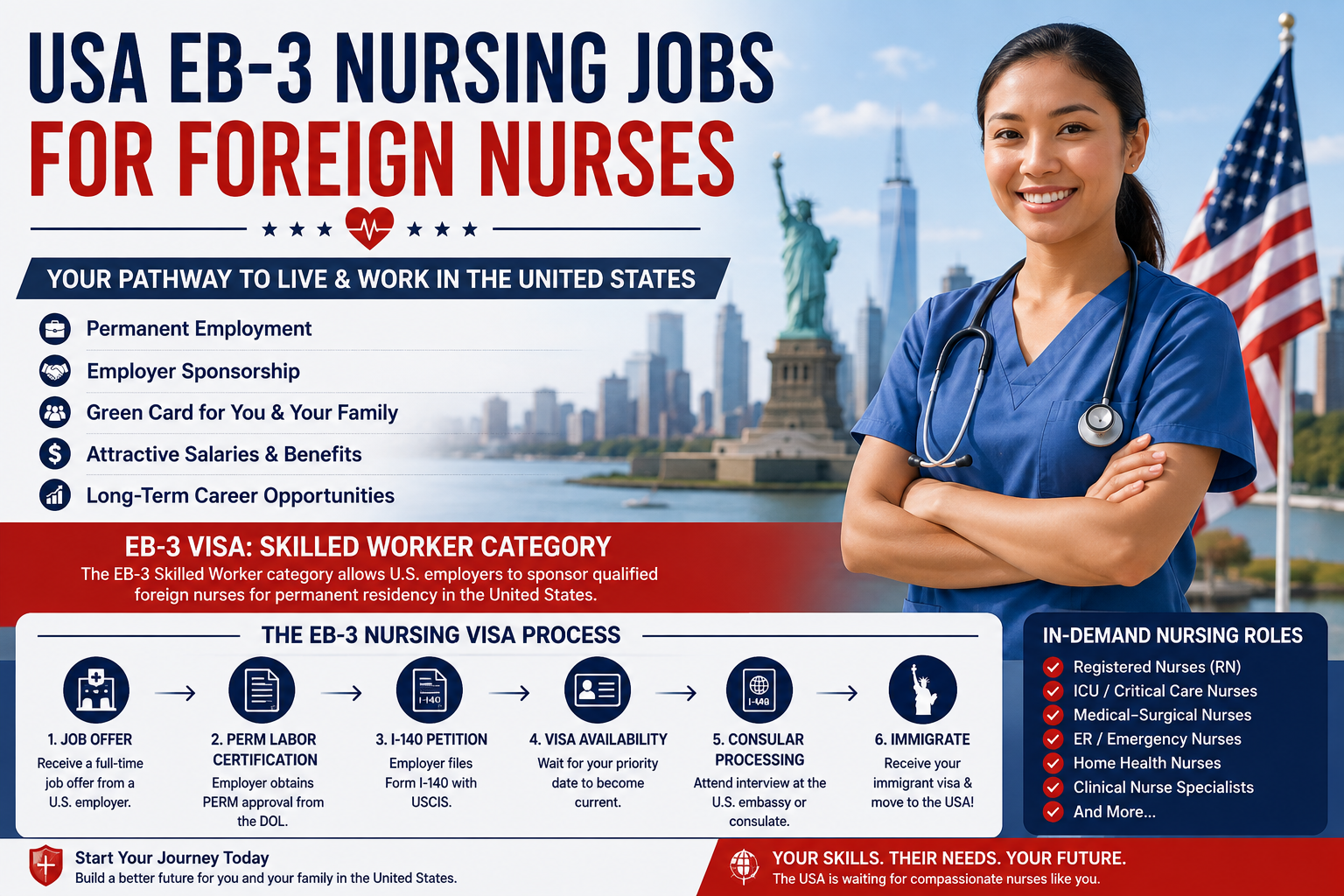
How Does the EB-3 Process Work for Nurses?
A simplified Schedule A nursing process can look like this:
- Meet nursing requirements: Establish that your education and professional background are suitable for US nursing registration.
- Complete required examinations or licensing steps: This can include NCLEX-RN and state-specific requirements.
- Find a qualifying US employer: Secure a genuine permanent nursing position.
- Employer completes Schedule A requirements: The employer prepares the required labour certification documentation, including the prevailing wage and notice requirements.
- Employer files Form I-140: The immigrant petition is submitted to USCIS with the Schedule A documentation.
- Wait for visa availability: Your priority date must become eligible under the applicable Visa Bulletin.
- Complete immigrant visa processing: Applicants living overseas normally proceed through the National Visa Center and US consular processing when eligible.
- Complete healthcare worker certification: Provide the required certification during the immigration process.
- Attend the required interview and medical examination: Complete the remaining immigrant visa requirements.
- Travel to the United States: If the immigrant visa is approved and you are admitted as an immigrant, you become a US permanent resident.
What Is Form I-140?
Form I-140 is the Immigrant Petition for Alien Workers.
For an employer-sponsored EB-3 nurse, the US employer generally files the petition with USCIS.
The petition establishes the employment-based immigrant classification being requested and includes supporting evidence concerning the employer, offered position and foreign worker.
Approval of Form I-140 is an important stage, but it does not necessarily mean the nurse can immediately receive a green card.
What Is a Priority Date?
Employment-based immigrant visas are subject to annual numerical limits.
Your priority date determines your place in the queue for an immigrant visa.
The US Department of State publishes a Visa Bulletin every month showing which priority dates are eligible for further action in the different employment-based categories.
This is extremely important for EB-3 nurses because demand can exceed the number of immigrant visas available.
Is EB-3 Currently Backlogged?
Yes. EB-3 should not currently be presented as an immediate green card route.
Visa availability depends on your country of chargeability and priority date.
For example, the August 2026 Visa Bulletin lists an EB-3 Final Action Date of 1 September 2024 for most countries.
Separate dates apply to applicants chargeable to China, India and the Philippines.
This means an approved petition does not necessarily result in immediate immigrant visa issuance.
Why Does Country of Birth Matter?
Employment-based immigration is subject to both category limits and country limits.
The Visa Bulletin therefore has separate columns for certain oversubscribed countries.
Your place of birth, rather than simply your current citizenship or country of residence, is generally important when determining chargeability.
There are circumstances where cross-chargeability through a spouse can apply, but this should be assessed based on the individual case.
Can Nurses From Nigeria Apply?
Yes. A qualified Nigerian registered nurse can potentially be sponsored for an EB-3 nursing position if the nurse and US employer satisfy all applicable requirements.
Nigeria currently falls under the Visa Bulletin’s general “All Chargeability Areas Except Those Listed” column rather than having a separate EB-3 country column.
This does not remove the EB-3 waiting period. The applicant’s priority date still needs to become eligible under the applicable Visa Bulletin.
Can Nurses From the Philippines Apply?
Yes. Filipino nurses have historically been an important part of international nursing recruitment in the United States.
However, the Philippines has its own EB-3 Visa Bulletin column because of demand.
As a result, visa availability can differ from the dates applying to many other countries.
Can Your Spouse and Children Get Green Cards?
Eligible spouses and unmarried children under 21 can generally immigrate as derivative beneficiaries of an employment-based immigrant.
This is an important distinction between permanent employment-based immigration and many temporary employment arrangements.
Each family member still needs to satisfy the applicable immigration and admissibility requirements.
Does EB-3 Give Nurses Permanent Residence?
EB-3 is an immigrant visa category.
If the process is successfully completed and the nurse is admitted to the United States as an employment-based immigrant, the nurse becomes a lawful permanent resident.
This provides significantly different status from somebody entering on a temporary non-immigrant work visa.
Permanent residence still comes with legal obligations and conditions, and it should not be confused with US citizenship.
Can You Apply Without a US Employer?
Generally, an EB-3 nursing case requires a qualifying US employer to sponsor the permanent position.
This is not a self-petition route simply because you are a nurse.
If somebody advertises an “EB-3 nursing visa” without identifying a genuine employer or permanent position, investigate carefully before paying anything.
What Nursing Specialities Can Employers Recruit?
US healthcare employers recruit registered nurses across different clinical areas depending on their staffing needs.
Positions can include:
- Medical-surgical nursing.
- Critical care nursing.
- Emergency nursing.
- Operating theatre nursing.
- Paediatric nursing.
- Home health nursing.
- Long-term care nursing.
- Mental health nursing.
The availability of a speciality does not mean every foreign applicant will qualify. Employers can require particular clinical experience and professional competencies.
How Much Do Nurses Earn in the USA?
Registered nurse salaries vary considerably according to state, city, employer, speciality and experience.
A nursing position in California, for example, may have a very different salary from a similar position in another state.
When considering an EB-3 offer, compare the salary with the cost of living in the location and check that the employment terms are clearly stated.
Do not choose an employer based solely on the largest advertised salary.
Questions to Ask Before Signing an EB-3 Nursing Contract
Before committing to an employer or recruiter, ask:
- Who will legally employ me?
- Which hospital or facility will I work at?
- Which state will I work in?
- What is the basic salary?
- How many contracted hours will I work?
- Who pays immigration-related costs?
- Is there a minimum employment commitment?
- Is there a repayment or penalty clause?
- What happens if my immigration case is delayed?
- What assistance is provided with state nursing licensing?
Get important promises in writing rather than relying on verbal assurances.
Watch Out for EB-3 Nursing Scams
International nurses should be particularly careful because permanent US employment is attractive to applicants and therefore also attracts fraudulent recruitment.
Warning signs can include:
- Guaranteed green card approval.
- A guaranteed immigration timeline.
- No identifiable US healthcare employer.
- A nursing job without checking your nursing credentials.
- Requests for large unexplained payments.
- Fake USCIS documents.
- Promises that you do not need professional licensing.
- Claims that the Visa Bulletin can be bypassed.
- Pressure to sign a contract immediately.
No legitimate recruiter can guarantee that USCIS or a US consular officer will approve an immigration application.
Frequently Asked Questions
Can a foreign nurse get a US green card through EB-3?
Potentially, yes. A qualifying US employer can sponsor an eligible professional nurse for permanent employment through the EB-3 immigration process.
Do nurses need normal PERM labour certification?
Professional nurses are Schedule A Group I workers. Their employers therefore use the special Schedule A process rather than completing the ordinary PERM recruitment and certification procedure used for many other occupations.
Do I need to pass NCLEX?
NCLEX-RN is one of the recognised ways of satisfying the Schedule A professional nursing evidence requirement. State nursing licensing requirements must also be considered.
Is EB-3 an immediate green card?
No. EB-3 immigrant visas are numerically limited, and applicants may need to wait until their priority date is eligible under the Visa Bulletin.
Can my family immigrate with me?
An eligible spouse and unmarried children under 21 can generally obtain derivative immigrant status with the principal EB-3 applicant, subject to applicable requirements.
Can I apply for EB-3 without a nursing job?
Generally, you need a qualifying US employer offering permanent employment and willing to sponsor the EB-3 petition.
Final Thoughts on EB-3 Nursing Jobs in the USA
EB-3 nursing jobs in the USA can provide qualified foreign registered nurses with a genuine employment-based pathway to US permanent residence.
The Schedule A designation makes professional nursing different from many other EB-3 occupations because the employer does not need to complete the normal PERM recruitment process.
However, there are still several important stages. Nurses need appropriate professional credentials, a genuine permanent US employment offer, an approved immigrant petition, healthcare worker certification and an available immigrant visa number.
Before signing with an employer or recruiter, verify the organisation, understand the nursing licensing requirements in the intended state and read every part of the employment agreement carefully.
Disclaimer: US immigration rules, Visa Bulletin dates, nursing licensing requirements and processing procedures can change. Always verify current requirements with USCIS, the US Department of State, the US Department of Labor and the appropriate state nursing authority before applying or making financial commitments.