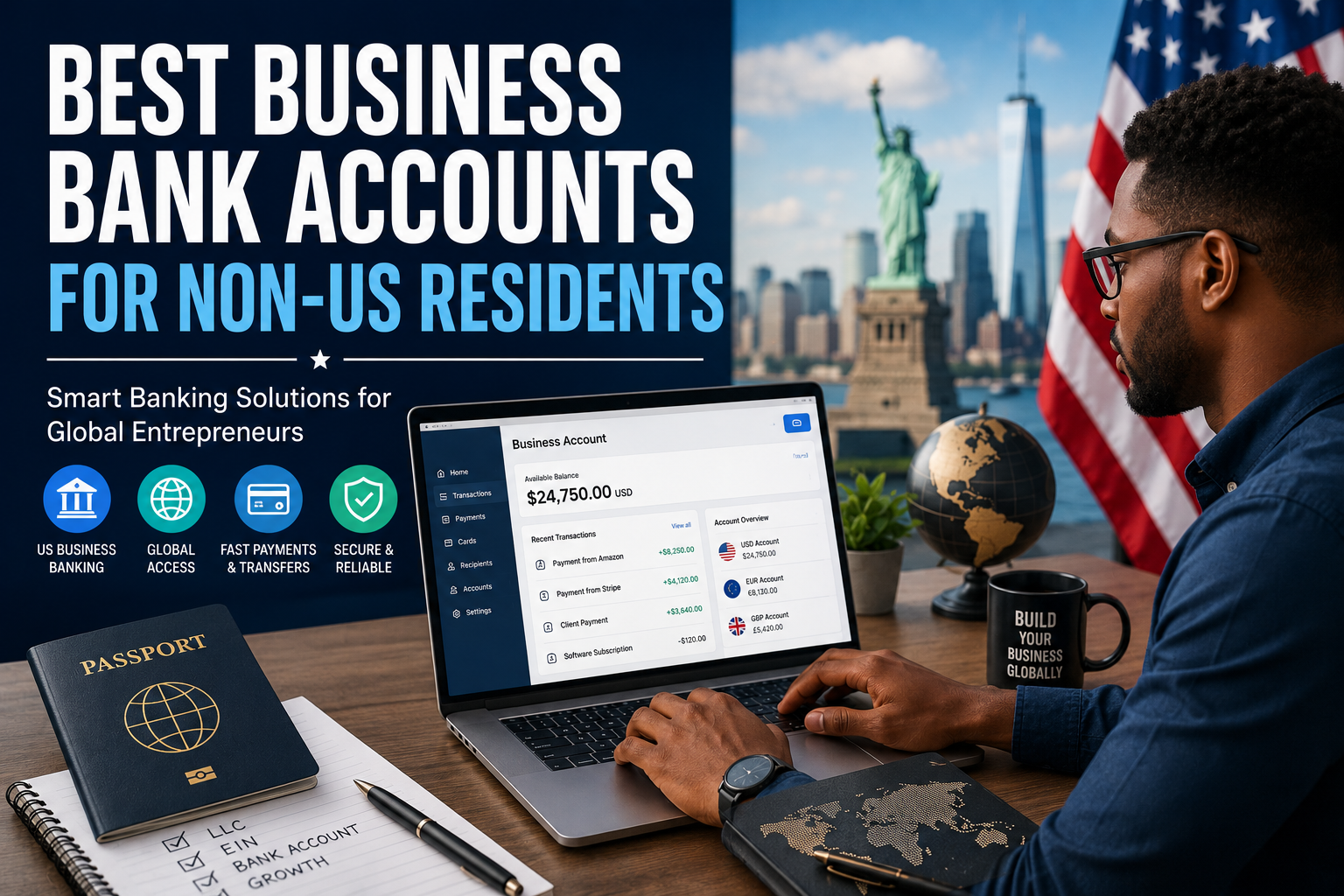
Best Business Bank Accounts for Non-US Residents
Opening a US business bank account as a foreign entrepreneur is possible, but choosing the right provider can be confusing.
Some providers support founders living outside the United States, while others require US residency. Some offer genuine business checking accounts through partner banks, while others provide payment accounts and local receiving details instead of traditional bank accounts.
That distinction matters.
If you own a US LLC from Nigeria, the UK, Ghana, Kenya, South Africa, the UAE or another country, you need to understand exactly what each provider offers before submitting an application.
In this guide, we compare some of the best business bank accounts for non-US residents, explain the requirements for foreign-owned LLCs, and look at alternatives for entrepreneurs who mainly need to receive USD payments from American customers.
Can Non-US Residents Open a US Business Bank Account?
Yes, in some circumstances.
You do not automatically need to be a US citizen or permanent resident to have access to US business banking.
However, eligibility depends heavily on the provider.
Some financial technology companies work with US banks and specifically support eligible US companies whose founders live abroad.
Other providers require the business owner to live in the United States even if US citizenship is not required.
This means forming a US LLC does not automatically guarantee that you will be approved for a bank account.
What Do Foreign Founders Usually Need?
Requirements differ between providers, but an international founder may be asked for:
- A valid passport or other government-issued identification.
- US company formation documents.
- An Employer Identification Number, commonly called an EIN.
- Information about company owners and directors.
- A genuine physical residential or business address.
- Information about what the company does.
- Details about customers or expected transactions.
- The source of company funds.
- Evidence of existing or planned US business activity.
Financial institutions also carry out identity, ownership and compliance checks before approving accounts.
Do You Need an SSN to Open a US Business Account?
Not always.
An SSN, or Social Security Number, is not necessarily required by every provider serving foreign founders.
For example, some providers can verify an overseas beneficial owner using a passport or other identification rather than a US Social Security Number.
However, the requirements depend on the provider, company structure and country of residence.
Do not assume that an EIN automatically replaces every personal identification requirement. An EIN identifies the business, while financial providers still need to verify the people who own and control it.
Best Business Banking Options for Non-US Residents
There is no single account that is best for everyone.
A SaaS founder with a Delaware corporation has different requirements from a freelancer who simply wants to receive USD payments from American clients.
Here are several options worth investigating.
1. Mercury
Mercury is one of the strongest options to investigate if you have a US-registered company but live outside the United States.
Mercury is a financial technology company rather than a bank itself. Banking services are provided through its partner banks.
Importantly for international entrepreneurs, Mercury states that founders do not need to be US citizens or US residents to apply.
Your company must, however, be formed and registered in the United States or a US territory.
Mercury Requirements for International Founders
According to Mercury’s current eligibility requirements, an eligible business generally needs:
- A company formed and registered in the United States or a US territory.
- Existing or planned operations in the United States.
- A genuine US or international physical address for the principal place of business.
- Business and ownership information.
- Supporting company documentation.
A residential address can potentially be used as the principal place of business.
However, Mercury does not accept a registered agent address, PO Box or certain mail receiving addresses as the company’s physical operating address.
Who Is Mercury Best For?
- US LLC owners living overseas.
- Technology startups.
- SaaS companies.
- Agencies.
- E-commerce businesses.
- Companies expecting significant US business activity.
Important Mercury Limitation
Mercury does not support founders or financial controllers residing in every country or region.
Therefore, check whether your country of residence is currently supported before forming a company specifically because you intend to apply for Mercury.
2. Wise Business
Wise Business is another useful option for internationally operated companies, particularly when the business needs to receive and send money in several currencies.
Wise Business allows eligible businesses to manage more than 40 currencies and send payments to numerous countries.
It can be particularly useful if your customers are spread across the United States, United Kingdom, Europe and other international markets.
Why Consider Wise Business?
- Multi-currency functionality.
- International business payments.
- Local account details for supported currencies and regions.
- Currency conversion.
- Ability to pay suppliers and contractors internationally.
Availability varies according to where the business operates and is registered.
Wise Requirements for a US Business
For a US business, Wise may request information including:
- Business name.
- Company type.
- EIN.
- Registered business address.
- Trading address.
- Information about directors.
- Information about beneficial owners.
- Personal identification.
Wise says that non-US beneficial owners can be asked to provide photographic identification, while US-resident or US-passport-holding beneficial owners may be asked for an SSN.
Physical Address Requirements
Wise distinguishes between a company’s registered address and its trading address.
The trading address must represent a physical location where the business operates.
Wise says it does not accept a PO Box, mail forwarding service, virtual office, attorney’s office or business registration agency as the trading address.
This is important for entrepreneurs who form an LLC using only a registered agent.
Who Is Wise Business Best For?
- International service businesses.
- Agencies with customers in several countries.
- Companies paying international contractors.
- Businesses frequently converting currencies.
- Entrepreneurs receiving payments in USD, GBP or EUR.
3. Payoneer
Payoneer is widely used by international entrepreneurs, freelancers and e-commerce sellers, but there is an important distinction you need to understand.
Payoneer is not a bank and does not provide a traditional US business bank account.
Instead, Payoneer is a financial technology company providing international business payment services.
Eligible customers can receive local receiving account details for supported currencies, including USD.
What Can You Do With Payoneer?
Depending on eligibility and location, businesses can use Payoneer to:
- Receive payments from international clients.
- Receive marketplace payouts.
- Access local receiving details in supported currencies.
- Hold supported currency balances.
- Pay suppliers and contractors.
- Withdraw funds to eligible local bank accounts.
Who Is Payoneer Best For?
- Amazon and other marketplace sellers.
- Freelancers.
- Agencies.
- Service providers.
- Businesses receiving cross-border payments.
If your primary objective is to receive USD from American clients rather than obtain a traditional US business checking account, Payoneer may be worth investigating.
4. Airwallex
Airwallex is designed primarily for businesses operating internationally.
Its platform focuses on global payments, multi-currency management, cards and expense management.
This can make it attractive to companies that operate across multiple countries rather than exclusively within the United States.
Airwallex Can Be Useful For:
- Global businesses.
- Technology companies.
- E-commerce companies.
- Companies paying international suppliers.
- Businesses managing several currencies.
Account availability and individual features depend on the country where the business is registered and the company’s eligibility.
Check current requirements directly before applying.
5. Relay
Relay is a US business banking platform focused on small businesses and cash-flow management.
Its tools can be useful for businesses that want to organise money into separate accounts and manage team spending.
However, international founders should verify Relay’s current residency, address and identification requirements before assuming that their foreign-owned company will qualify.
Relay Can Be Useful For:
- Small businesses.
- Agencies.
- Businesses managing multiple operating budgets.
- Companies needing team spending controls.
Because eligibility policies can change, check the current requirements before applying from outside the United States.
What About Novo?
Novo is frequently included in lists of US business accounts for foreign entrepreneurs, but this needs clarification.
Novo allows some non-US citizens to apply, but its published eligibility information states that these applicants must live in the United States.
Therefore, someone operating a US LLC entirely from Nigeria, Ghana, the UK, Kenya or another overseas country should not assume that Novo is available simply because they own a US company.
Novo may still be relevant to eligible non-US citizens who are actually resident in the United States.
Comparison of Business Account Options
| Provider | Best For | Non-US Founder | Multi-Currency | Important Point |
|---|---|---|---|---|
| Mercury | US startups and LLCs | Yes, subject to eligibility | Limited compared with Wise | US-registered company required |
| Wise Business | International businesses | Depends on supported country and verification | Strong | Excellent for cross-border payments |
| Payoneer | Freelancers and e-commerce | Broad international availability | Strong | Not a traditional bank account |
| Airwallex | Global companies | Depends on business location and eligibility | Strong | Focused on global financial operations |
| Relay | Small businesses and agencies | Check current eligibility | Limited | Useful cash-management features |
Which Option Is Best for a Foreign-Owned US LLC?
If you own a US LLC but live outside America, start by identifying what you actually need.
If you want a US business checking account and your US company meets the eligibility requirements, Mercury is one of the first providers worth investigating.
If your biggest concern is receiving, holding and converting several currencies, Wise Business may be more appropriate.
If you mainly need to receive marketplace or international business payments, Payoneer may provide the functionality you need without pretending to be a traditional bank account.
A growing company may even use more than one financial provider for different purposes, provided doing so is appropriate for its accounting, tax and compliance requirements.
How to Open a US Business Account as a Non-Resident
The exact application process depends on the provider, but foreign founders can prepare using the following steps.
Step 1: Form Your US Company
If your chosen provider requires a US-registered company, you will first need an appropriate legal business entity.
Many international entrepreneurs use an LLC, although corporations can be more appropriate for certain businesses.
Do not choose a company structure solely because you saw someone recommend it online. Tax and reporting consequences can vary significantly.
Step 2: Obtain an EIN
An Employer Identification Number is the federal tax identification number assigned to a business by the Internal Revenue Service.
Many business banking providers request an EIN during account opening.
An EIN can also be important for tax reporting and other business activities.
Step 3: Prepare Your Formation Documents
Depending on your business structure and provider, documentation may include:
- Articles of Organization or incorporation documents.
- Operating Agreement.
- EIN documentation.
- Ownership information.
- Director information.
- Business licences where applicable.
Step 4: Prepare Proof of Your Physical Address
This is where many overseas founders run into problems.
A registered agent address is not necessarily considered your business’s physical operating address.
Providers may request evidence showing where you or your company genuinely operate.
Depending on the provider, acceptable evidence can include a residential address supported by identification, bank statements, utility bills, tenancy documents or other recognised documents.
Step 5: Be Ready to Explain Your Business
Financial providers need to understand who they are onboarding.
Be prepared to explain:
- What your company sells.
- Where customers are located.
- How the company earns money.
- Expected transaction volumes.
- Where company funds originate.
- Whether you have existing or planned US operations.
If you have a business website, online store or other legitimate online presence, make sure the information accurately reflects your business.
Step 6: Complete Identity Verification
You may need to provide a passport or other government-issued identification.
Providers can also request information about beneficial owners, directors and people controlling the business.
This is part of normal financial compliance.
Can You Open a US Business Account Without Visiting America?
Potentially, yes.
Some providers allow eligible businesses to complete onboarding online.
Mercury, for example, specifically supports eligible US companies founded by people living outside the United States.
However, remote application does not mean automatic approval.
Your company still needs to satisfy the provider’s eligibility, identity verification and compliance requirements.
Can You Open an Account With Only an EIN?
Usually not.
An EIN is important, but providers generally need considerably more information.
You may also need:
- Passport or identification.
- Company documents.
- Physical address.
- Ownership information.
- Business activity information.
Be cautious of advertisements claiming that an EIN alone guarantees access to US banking.
Registered Agent Address vs Physical Business Address
These are not necessarily the same thing.
Your registered agent receives legal and official correspondence for your company.
Your financial provider may separately want to know where the business is actually operated.
For example, Mercury allows eligible overseas founders to provide a verifiable international physical address but does not accept a registered agent, PO Box or similar mail address as the company’s principal physical address.
Wise also requires a genuine trading address and does not treat a virtual office or mail forwarding service as a trading location.
Best Option for Receiving USD From US Clients
You may not actually need a traditional US business bank account.
If your main requirement is simply getting paid by American customers in dollars, a payment provider offering USD receiving details could potentially meet your needs.
Payoneer, for example, provides eligible customers with local receiving account details that can be used to receive supported business payments.
Wise Business can also provide account details for supported currencies and regions, subject to availability and eligibility.
Best Option for International Agencies
An agency serving customers in several countries should pay particular attention to currency conversion and international transfer costs.
Imagine an agency receiving:
- USD from American customers.
- GBP from British customers.
- EUR from European customers.
- CAD from Canadian customers.
Automatically converting every payment into one home currency can increase transaction costs.
A multi-currency platform can make it easier to receive, hold and send supported currencies according to the needs of the business.
Wise Business and Airwallex are particularly relevant to investigate for this type of operation.
Best Option for Amazon and E-Commerce Sellers
E-commerce businesses often need more than a normal checking account.
Important requirements can include:
- Marketplace payouts.
- USD receiving details.
- Supplier payments.
- Currency conversion.
- International transfers.
Payoneer has extensive marketplace payment functionality and provides local receiving accounts to eligible users.
Wise Business can also be useful for international currency management.
A US-incorporated e-commerce company meeting Mercury’s requirements may consider Mercury for its primary business banking relationship.
Best Option for SaaS Companies
A software company operating internationally may prioritise:
- US banking functionality.
- Payment processor compatibility.
- International payments.
- Corporate cards.
- Accounting integrations.
- Investor-friendly financial infrastructure.
Mercury has built much of its offering around startups and technology businesses, making it an option worth considering for eligible US companies.
Wise Business or Airwallex may complement that infrastructure where extensive international currency management is required.
Bank Account vs Payment Account: Know the Difference
Do not assume every service giving you a routing number and account number is a bank.
This distinction is particularly important when comparing international financial services.
For example, Payoneer clearly states that it is not a bank and that its receiving accounts should not be confused with traditional business bank accounts.
Similarly, some fintech companies provide banking services through regulated partner banks rather than being banks themselves.
Always check:
- Who legally provides the account.
- Where your money is held.
- Whether deposit insurance applies.
- What protections apply to your funds.
- Whether the account supports the transactions you require.
Can Non-US Residents Build US Business Credit?
Potentially, but opening a business bank account does not automatically establish a strong business credit profile.
Business credit can depend on factors including the company, lender, credit reporting arrangements, payment history and financial activity.
Some businesses eventually become eligible for:
- Business credit cards.
- Vendor financing.
- Equipment financing.
- Lines of credit.
- Working capital.
However, financing products have their own eligibility requirements and can sometimes require personal guarantees or US credit history.
Avoid assuming that forming an LLC and obtaining an EIN will automatically give you access to large amounts of US credit.
Common Mistakes Foreign Founders Should Avoid
Assuming Every Provider Accepts Non-Residents
Non-US citizen and non-US resident are not the same thing.
A provider may accept a non-US citizen while still requiring that person to live in America.
Using Only a Registered Agent Address
Some providers require a genuine physical operating or residential address.
Check the address rules before applying.
Assuming an EIN Guarantees Approval
An EIN is only one part of the application.
Providers still perform identity, ownership, business and compliance checks.
Calling Every Fintech Account a Bank Account
Understand whether you are receiving a genuine bank account, banking services provided through a partner bank, or payment receiving details.
Applying With Inconsistent Business Information
Your company formation records, website, business description and application should accurately describe the same legitimate business.
Ignoring Country Restrictions
A provider may support international founders generally while excluding applicants living in particular countries or regions.
Check current eligibility before spending money forming a company specifically to access a particular financial provider.
Choosing an Account Based Only on Monthly Fees
A zero monthly fee does not necessarily make an account cheaper.
Consider:
- Currency conversion charges.
- Wire fees.
- International transfer costs.
- Receiving fees.
- Card charges.
- Withdrawal fees.
How to Choose the Right Provider
Before opening an account, answer these questions:
- Is my country of residence supported?
- Does the provider support my company structure?
- Do I need a US-registered company?
- Does the provider require US residency?
- Can I use my genuine international residential address?
- Do I need USD receiving details?
- Do I need multiple currencies?
- Will I pay international suppliers?
- Do I need physical or virtual cards?
- What are the total fees for how I will actually use the account?
The answers should determine which provider you choose.
Frequently Asked Questions
Can a Non-US Resident Open a US Business Bank Account?
Yes, some providers support eligible non-US residents. Requirements depend on the financial provider, company structure, country of residence and business activity.
Can I Open Mercury if I Don’t Live in America?
Potentially, yes. Mercury states that it supports eligible US companies founded by people around the world. Your company must be registered in the United States or a US territory and satisfy Mercury’s other eligibility requirements.
Do I Need an SSN?
Not necessarily. Some providers can verify foreign owners using passports or other documentation. Requirements vary by provider.
Do I Need an EIN?
Many providers serving US companies request an EIN. It is therefore an important document for foreign owners of US LLCs and corporations.
Can I Use My Registered Agent Address?
Not necessarily as your physical business address. Some providers specifically require a genuine physical location and will not accept a registered agent, virtual office or mail receiving address for that purpose.
Is Payoneer a US Bank Account?
No. Payoneer states that it is not a bank. It provides business payment services and can give eligible customers local receiving account details for supported currencies.
Is Wise Business a Good Option for International Businesses?
It can be particularly useful for eligible businesses that receive and send money internationally or manage multiple currencies. Availability and features depend on the business’s country and verification status.
Can I Open Novo From Outside the United States?
Novo’s published eligibility guidance states that non-US citizens can apply in certain circumstances but must live in the United States. Therefore, it should not be treated as a general solution for an overseas founder operating entirely from another country.
Can I Open a Business Account With an EIN Only?
Usually, additional information is required. Providers may request identification, formation documents, ownership information, addresses and details about the company’s activities.
Which Account Is Best for a Foreign-Owned LLC?
There is no universal answer. Mercury is worth investigating for eligible US-registered businesses owned by overseas founders. Wise Business can be attractive for international currency management, while Payoneer can be useful where the primary requirement is receiving cross-border business payments.
Final Thoughts
The best business bank accounts for non-US residents depend on where you live, where your company is registered and what you actually need the account to do.
For an eligible foreign founder with a US-registered company, Mercury is one of the strongest options to investigate because it explicitly supports qualifying companies founded by people living outside America.
For businesses managing several currencies, Wise Business may provide more useful international functionality.
For freelancers, marketplace sellers and businesses primarily looking for cross-border payment infrastructure, Payoneer can be valuable, but it should not be described as a traditional US bank account.
Most importantly, do not form an LLC or pay a service provider simply because somebody promises that doing so will guarantee you a US bank account.
Check the provider’s current country restrictions, company requirements, address rules, identification requirements and fees first.
Banking eligibility can change, and every application remains subject to verification and approval.
Disclaimer: This article is for general information only and does not constitute financial, legal or tax advice. Banking products, eligibility requirements, fees and country restrictions can change. Verify the latest information directly with the relevant provider before applying or making financial commitments.