
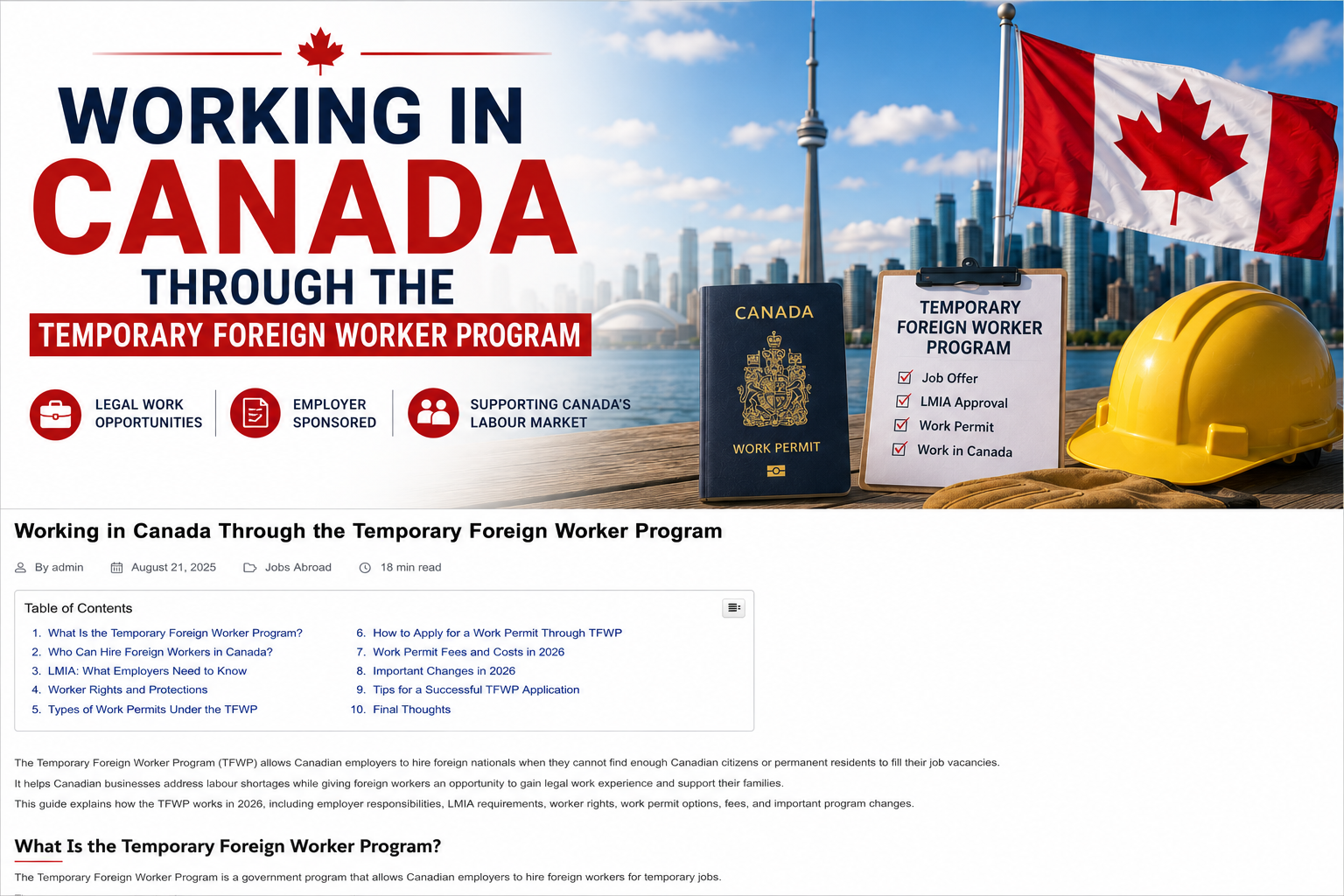
Canada Temporary Foreign Worker Program 2026: How to Apply
The Canada Temporary Foreign Worker Program 2026 allows eligible Canadian employers to hire foreign nationals temporarily when they cannot find suitable Canadian citizens or permanent residents to fill particular positions.
The programme is commonly associated with a Labour Market Impact Assessment, known as an LMIA. In most cases, the employer must obtain a positive LMIA before the foreign worker can apply for an employer-specific Canadian work permit.
This guide explains how the Temporary Foreign Worker Program (TFWP) works, the main streams, employer responsibilities, work permit process, fees and important protections for foreign workers.
What Is the Canada Temporary Foreign Worker Program?
The TFWP is designed to help Canadian employers address temporary labour needs when qualified Canadians and permanent residents are not available.
The programme is primarily administered by Employment and Social Development Canada (ESDC), while Immigration, Refugees and Citizenship Canada (IRCC) handles the foreign worker’s work permit application.
The TFWP should not be confused with the International Mobility Program. The TFWP generally requires an LMIA, while the International Mobility Program allows eligible employers to hire certain foreign workers without an LMIA.
What Is an LMIA?
A Labour Market Impact Assessment is an assessment that a Canadian employer may need before hiring a temporary foreign worker.
ESDC considers whether hiring the foreign national is expected to have a positive or neutral impact on Canada’s labour market. The employer may need to demonstrate that reasonable efforts were made to recruit Canadians and permanent residents.
If the application is successful, the employer receives a positive LMIA. The foreign worker can then use the relevant LMIA information when applying for an employer-specific work permit.
Importantly, the employer applies for the LMIA, not the foreign worker.
What Jobs Are Available Through the TFWP?
The Temporary Foreign Worker Program is divided into different streams rather than providing one universal list of jobs.
Depending on the employer and occupation, these can include:
- High-wage positions.
- Low-wage positions.
- Primary agriculture positions.
- Seasonal Agricultural Worker Program positions.
- Global Talent Stream positions.
- Certain in-home caregiver positions.
Each stream has its own employer requirements. A vacancy being described as a “Canada sponsorship job” online does not automatically mean that it qualifies under the TFWP.
High-Wage and Low-Wage Positions
Canada uses provincial and territorial wage thresholds to help determine whether an LMIA application falls within the high-wage or low-wage stream.
The thresholds are updated periodically. This means a salary that qualifies as high-wage in one province may be treated differently elsewhere.
Employers applying for high-wage positions generally have additional requirements, including providing a transition plan explaining activities intended to reduce their reliance on temporary foreign workers.
Low-wage positions have separate requirements and restrictions. The Government of Canada also applies limits to the proportion of low-wage temporary foreign workers that certain employers can employ.
Foreign applicants should therefore avoid relying on old wage figures when deciding whether a job qualifies.
Requirements for Low-Wage TFWP Jobs
Current federal requirements state that employment offered under the low-wage stream must generally be full-time, meaning at least 30 hours of work per week.
Additional employer obligations can relate to recruitment, wages, transportation, housing and health insurance depending on the particular stream and worker.
Some low-wage LMIA applications can also be affected by unemployment rates and federal restrictions on where applications will be processed.
Employers should check the current low-wage TFWP requirements before attempting to recruit an overseas worker.
How to Find TFWP Jobs in Canada
Foreign workers do not apply directly to the Canadian government for a TFWP job. You first need to find a genuine Canadian employer willing and eligible to hire a temporary foreign worker.
A sensible process is:
- Search for suitable vacancies: Concentrate on jobs matching your genuine qualifications and experience.
- Check whether overseas applicants are accepted: Not every Canadian employer recruits internationally.
- Verify the employer: Check its official website, contact details and vacancy information independently.
- Apply for the job: Follow the employer’s normal recruitment process.
- Attend interviews: A genuine employer will normally assess whether you are suitable for the position.
- Receive a genuine employment offer: The employer then completes the appropriate LMIA process if one is required.
Canada’s official Job Bank for foreign candidates is one useful starting point for identifying employers recruiting internationally.
Who Pays the LMIA Fee?
For many TFWP streams, the LMIA processing fee is currently CAD $1,000 for each position requested. Certain positions are exempt from the fee.
This is an employer expense. The Government of Canada specifically states that the LMIA processing fee cannot be paid by or recovered from temporary foreign workers.
Employers must also ensure that recruiters acting on their behalf do not charge or recover prohibited recruitment fees from workers. :contentReference[oaicite:0]{index=0}
If someone asks you to pay CAD $1,000 so they can “buy an LMIA” for you, treat this as a major warning sign.
How to Get a Work Permit Through the TFWP
Receiving a positive LMIA does not automatically give a foreign worker permission to enter or work in Canada.
The normal process is:
- The Canadian employer identifies a genuine labour need.
- The employer completes the required recruitment process.
- The employer applies to ESDC for an LMIA.
- If approved, the employer provides the worker with the required employment and LMIA information.
- The foreign worker applies to IRCC for an employer-specific work permit.
- The worker provides biometrics, medical information or additional documents where required.
- IRCC decides whether to approve the work permit application.
Never resign from employment, buy non-refundable flights or make major financial commitments simply because an employer says an LMIA has been submitted.
Canada Work Permit Fees in 2026
The worker’s immigration costs are separate from the employer’s LMIA fee.
The standard Canadian work permit processing fee is currently CAD $155 per person. Biometrics can also be required and currently cost CAD $85 for an individual.
Other legitimate personal costs may include medical examinations, police certificates, document translations and travel expenses, depending on the circumstances.
Government fees can change, so applicants should verify current charges through IRCC’s official work permit application guidance before paying.
Your Rights as a Temporary Foreign Worker
Foreign workers in Canada are protected by Canadian employment laws. Temporary status does not give an employer permission to ignore workplace standards.
Your employer must provide a signed employment agreement, pay you according to that agreement and comply with applicable employment standards. Employers must also make reasonable efforts to provide a workplace free from abuse. :contentReference[oaicite:1]{index=1}
Your employer cannot:
- Take your passport or work permit from you.
- Force you to perform unsafe work.
- Punish you for reporting mistreatment or unsafe conditions.
- Make you reimburse prohibited recruitment fees.
- Deport you or personally change your immigration status.
You can learn more through the Government of Canada foreign worker rights guidance.
Important TFWP Rules in 2026
The Temporary Foreign Worker Program continues to change in response to labour market conditions. Employers must use the current wage thresholds and requirements applying when they submit an LMIA application.
Canada also has temporary measures running from April 2026 to March 2027 that allow participating provinces and territories to support eligible rural employers seeking workers for certain low-wage positions.
Not every province participates in every measure, and these changes do not mean that all foreign applicants qualify for Canadian employment.
Applicants should therefore verify current programme requirements rather than relying on social media posts or old articles.
Can TFWP Workers Get Permanent Residence?
The Temporary Foreign Worker Program itself is not a permanent residence programme.
However, some foreign workers may later qualify separately for Canadian permanent residence depending on their occupation, Canadian work experience, education, language ability and other eligibility factors.
Possible routes can include Express Entry, Provincial Nominee Programs and regional immigration programmes.
A temporary job should never be presented as guaranteed Canadian permanent residence.
Avoid Fake LMIA and TFWP Job Offers
Foreign workers should be particularly cautious about people selling supposed Canadian jobs or LMIAs.
- Verify the employer independently.
- Do not pay the employer’s LMIA processing fee.
- Be cautious about large recruitment charges.
- Do not submit fake employment or qualification documents.
- Do not trust promises of guaranteed work permits.
- Do not trust promises of guaranteed permanent residence.
Canadian authorities require employers to ensure that workers are not charged prohibited recruitment fees. Employers who fail to meet programme conditions can face compliance action. :contentReference[oaicite:2]{index=2}
Final Thoughts on the Canada Temporary Foreign Worker Program 2026
The Canada Temporary Foreign Worker Program 2026 provides a legal mechanism for eligible Canadian employers to recruit foreign workers when genuine temporary labour needs cannot be met locally.
For an overseas applicant, the process normally begins by finding a legitimate employer rather than purchasing an LMIA. The employer handles the LMIA application where required, while the foreign worker subsequently applies for the appropriate work permit.
Verify employers carefully, understand who is responsible for each fee and use official Canadian government information throughout the process.
Disclaimer: Canadian immigration, LMIA, wage, work permit and Temporary Foreign Worker Program rules can change. This article provides general information and is not immigration or legal advice. Always confirm current requirements through Immigration, Refugees and Citizenship Canada and Employment and Social Development Canada before applying.