Healthcare Jobs in Canada for Foreign Workers
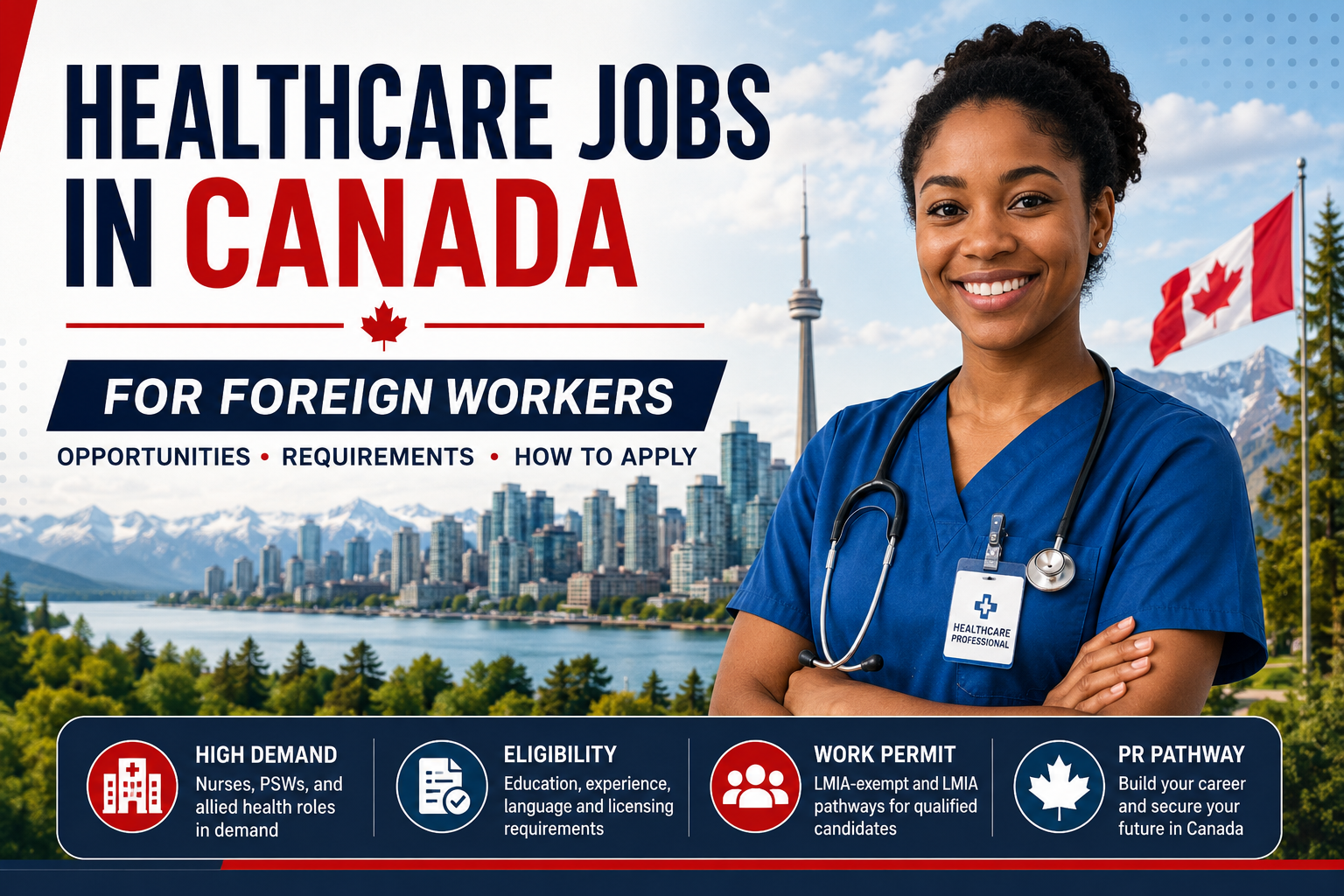
Healthcare jobs in Canada can offer opportunities for qualified foreign professionals looking to build careers in nursing, personal care, therapy, medical technology and other health-related occupations.
Canada has a large healthcare system operated across its provinces and territories. However, getting a healthcare job as an overseas applicant involves more than simply finding an employer.
Depending on your profession, you may need Canadian professional registration, recognition of your overseas qualifications, language evidence and legal permission to work in Canada.
This guide explains the main healthcare occupations to investigate, how professional licensing works and the immigration options that may allow foreign healthcare workers to work in Canada.
Can Foreigners Get Healthcare Jobs in Canada?
Yes. Foreign nationals can work in Canadian healthcare if they meet the requirements for their occupation and obtain the appropriate immigration status.
The process depends heavily on the job.
A registered nurse arriving from overseas, for example, faces different professional requirements from somebody applying for certain healthcare support positions.
This is because many Canadian healthcare professions are regulated.
Healthcare Jobs to Consider in Canada
Canada’s healthcare workforce covers hundreds of different occupations.
Foreign professionals may find opportunities in areas such as:
- Registered nursing.
- Licensed practical nursing.
- Nurse practitioner roles.
- Personal support work.
- Healthcare assistance.
- Medical laboratory technology.
- Medical radiation technology.
- Physiotherapy.
- Occupational therapy.
- Pharmacy.
- Respiratory therapy.
- Dental healthcare.
- Social and community services.
- Home support and care work.
The requirements, salaries and employment prospects differ considerably between these occupations.
Nursing Jobs in Canada for Foreign Workers
Nursing is one of the first professions many overseas healthcare workers consider when researching Canada.
Registered nurses work in environments including hospitals, community health centres, long-term care facilities, clinics and home healthcare services.
However, nursing is a regulated profession.
An overseas nursing qualification does not automatically allow you to begin working as a registered nurse in Canada.
You generally need to complete the registration process required by the nursing regulator in the province or territory where you want to practise.
How Much Do Registered Nurses Earn?
According to Canada’s Job Bank, wages for registered nurses vary by province, experience and employer.
The national median wage is currently around CAD $43.27 per hour.
Actual earnings can be higher or lower depending on where you work.
For example, wages in some provinces and northern regions can differ considerably from salaries offered elsewhere in Canada.
Always check current Job Bank wage information for your exact occupation and province rather than relying on a single national salary figure.
Healthcare Assistant and Support Jobs
Not every healthcare opportunity requires someone to become a registered nurse or doctor.
Canada also employs workers who provide personal care and support to older adults, people with disabilities and individuals requiring assistance with daily activities.
Job titles can vary between provinces and employers.
They can include:
- Personal support worker.
- Healthcare aide.
- Health care assistant.
- Continuing care assistant.
- Home support worker.
- Patient care aide.
Do not assume these titles are interchangeable. The training and certification requirements depend on the province and position.
Do You Need Canadian Healthcare Registration?
If your occupation is regulated, you need authorisation from the appropriate provincial or territorial regulatory body before practising under the protected professional title.
Regulated healthcare occupations can include professions such as:
- Nursing.
- Medicine.
- Pharmacy.
- Physiotherapy.
- Occupational therapy.
- Medical laboratory technology.
The exact regulatory process differs by profession and location.
You should therefore decide which province you want to work in and identify the regulator responsible for your profession.
Internationally Educated Nurses
Nurses educated outside Canada may need to have their education, professional registration and employment history assessed before becoming licensed.
Depending on the province, internationally educated nurses may interact with the National Nursing Assessment Service and the relevant provincial nursing regulator.
The assessment process can examine areas such as:
- Your nursing education.
- Previous professional registration.
- Employment history.
- Identity documents.
- Language proficiency.
Additional examinations, education or competency assessments may be required depending on the regulator’s assessment.
Do You Need IELTS for Healthcare Jobs?
Language requirements depend on your profession, regulator and immigration pathway.
A professional regulatory organisation may require evidence that you can communicate safely and effectively in English or French.
Separately, an immigration programme may have its own language requirements.
This means satisfying a professional regulator’s language requirement does not necessarily mean you automatically satisfy every Canadian immigration requirement.
How to Find Healthcare Jobs in Canada
If you are applying from overseas, concentrate on genuine healthcare employers and vacancies that match your qualifications.
A practical job-search process is:
- Identify your Canadian occupation: Determine how your current profession is classified in Canada.
- Choose a province: Research where your skills are needed and where you would realistically live.
- Check regulation: Determine whether your profession requires provincial registration.
- Start credential recognition: Complete the necessary assessment where required.
- Prepare a Canadian-style CV: Clearly present your qualifications and relevant clinical experience.
- Search healthcare employers: Look at hospitals, health authorities, care organisations and other legitimate employers.
- Use Canada’s Job Bank: Search for vacancies matching your occupation.
- Check work authorisation: Determine whether the employer can recruit somebody who does not currently have Canadian work authorisation.
Where Should You Look for Healthcare Vacancies?
Canada’s official Job Bank is a useful starting point.
You can also investigate:
- Provincial health authority career websites.
- Hospital career pages.
- Long-term care organisations.
- Community healthcare providers.
- Home care providers.
- Provincial healthcare recruitment initiatives.
When possible, apply directly through an employer’s official recruitment website.
Do Canadian Healthcare Employers Sponsor Foreign Workers?
Some Canadian healthcare employers recruit internationally, but the word “sponsorship” can cause confusion.
Canada does not operate one universal healthcare sponsorship visa.
Instead, the immigration process depends on the worker, employer, occupation and immigration programme.
Some employers may need a Labour Market Impact Assessment, commonly called an LMIA, before a foreign worker can apply for an employer-specific work permit.
Other situations may qualify for an LMIA exemption.
What Is an LMIA?
A Labour Market Impact Assessment is an assessment that some Canadian employers need before hiring temporary foreign workers.
The employer applies for the LMIA, not the worker.
If a positive LMIA is required and granted, the employer can provide the relevant documentation that the foreign worker needs when applying for an employer-specific work permit.
A positive LMIA does not automatically guarantee that the worker’s work permit application will be approved.
How to Get a Canadian Work Permit for a Healthcare Job
The exact process depends on whether the position requires an LMIA or qualifies for an exemption.
A typical employer-specific process can involve:
- Meeting the professional requirements for your healthcare occupation.
- Finding a genuine Canadian employer.
- Receiving a written employment offer.
- The employer completing the appropriate LMIA or LMIA-exempt process.
- Preparing your work permit application.
- Submitting supporting documents.
- Providing biometrics where required.
- Completing a medical examination where required.
- Waiting for Immigration, Refugees and Citizenship Canada to make a decision.
Medical Examinations for Healthcare Workers
Healthcare workers should pay particular attention to Canada’s medical examination requirements.
Workers whose jobs bring them into close contact with people may need an immigration medical examination before being authorised to work in certain occupations.
This can apply to jobs in healthcare settings.
Use a panel physician approved by Immigration, Refugees and Citizenship Canada when an immigration medical examination is required.
Can Healthcare Workers Apply for Permanent Residence?
Potentially, yes.
Canada has several economic immigration pathways, and qualifying healthcare professionals may be eligible depending on factors such as their occupation, work experience, education and language ability.
Express Entry is one important system to understand.
Canada also conducts category-based Express Entry invitation rounds targeting candidates with eligible occupational experience, including healthcare and social services occupations.
The list of eligible occupations can change, so always check the current IRCC category requirements.
Healthcare and Social Services Express Entry Category
Canada’s category-based selection system allows IRCC to conduct invitation rounds targeting candidates with particular skills or professional backgrounds.
Healthcare and social services is one of the categories used for these selections.
Eligible occupations can include various roles in areas such as:
- Nursing.
- Medicine.
- Pharmacy.
- Therapy.
- Medical technology.
- Social work.
- Other qualifying healthcare occupations.
Being employed in healthcare does not automatically guarantee an Express Entry invitation.
You must first qualify for an Express Entry programme and satisfy the requirements of the relevant category-based invitation round.
Provincial Nominee Program Options
Healthcare workers can also investigate Provincial Nominee Programs.
Canadian provinces and territories operate immigration streams based on their own economic and labour market needs.
Some provinces periodically target healthcare professionals or operate specific initiatives designed to attract workers into occupations experiencing shortages.
The eligibility requirements vary significantly.
A programme available to nurses in one province may operate completely differently from a healthcare pathway elsewhere.
Can You Apply From Outside Canada?
Yes. Overseas healthcare professionals can apply for Canadian employment and immigration programmes from outside Canada where they meet the applicable requirements.
However, professional licensing can make healthcare recruitment more complicated than applying for an unregulated occupation.
Starting your credential recognition early can therefore be important.
Can Your Family Come With You?
Whether family members can accompany you depends on your immigration status and Canada’s rules at the time they apply.
Eligible spouses and dependent children may be able to accompany a foreign worker.
However, eligibility for a spousal open work permit is subject to specific rules and should not be assumed simply because the principal applicant has obtained a Canadian work permit.
Watch Out for Fake Healthcare Job Offers
Foreign healthcare professionals should be cautious about recruitment scams.
Warning signs can include:
- Guaranteed Canadian permanent residence.
- A job offered without assessing your qualifications.
- Claims that professional licensing requirements can be ignored.
- Requests to purchase an LMIA.
- Large recruitment payments sent to personal bank accounts.
- Emails using addresses unrelated to the employer’s official domain.
- Unrealistically high salaries.
- Pressure to pay immediately.
Verify the employer independently before paying money or providing sensitive documents.
Frequently Asked Questions
Can foreigners work in Canadian healthcare?
Yes. Foreign healthcare professionals can potentially work in Canada if they meet professional, employer and immigration requirements.
Can I work as a nurse immediately after arriving in Canada?
Not necessarily. Nursing is regulated, and you generally need authorisation from the relevant provincial or territorial nursing regulator before practising as a registered nurse.
Do healthcare jobs provide permanent residence?
A healthcare job does not automatically provide permanent residence. However, qualifying healthcare workers may be eligible for federal or provincial immigration pathways.
Do I need a job offer before applying for Express Entry?
Not necessarily. Some Express Entry programmes do not require a Canadian job offer. Your eligibility depends on the specific programme and your circumstances.
Can healthcare workers apply from overseas?
Yes. Overseas candidates can potentially secure employment and complete immigration processes from outside Canada, although professional registration may need to be addressed.
Final Thoughts on Healthcare Jobs in Canada
Healthcare jobs in Canada can provide attractive opportunities for qualified foreign workers, but healthcare immigration should be approached as a combination of professional licensing, employment and immigration.
Before applying to hundreds of vacancies, identify your Canadian occupation, choose the province where you want to work and determine whether your profession is regulated.
Once you understand the licensing requirements, you can target genuine employers and investigate the work permit or permanent residence pathway appropriate to your circumstances.
Disclaimer: Canadian immigration programmes, professional licensing requirements, salaries and occupational eligibility can change. Always confirm current requirements with Immigration, Refugees and Citizenship Canada and the relevant provincial professional regulator before applying or making financial decisions.